 Photo: Sergei Prokudin-Gorskii · Public domain · source ↗

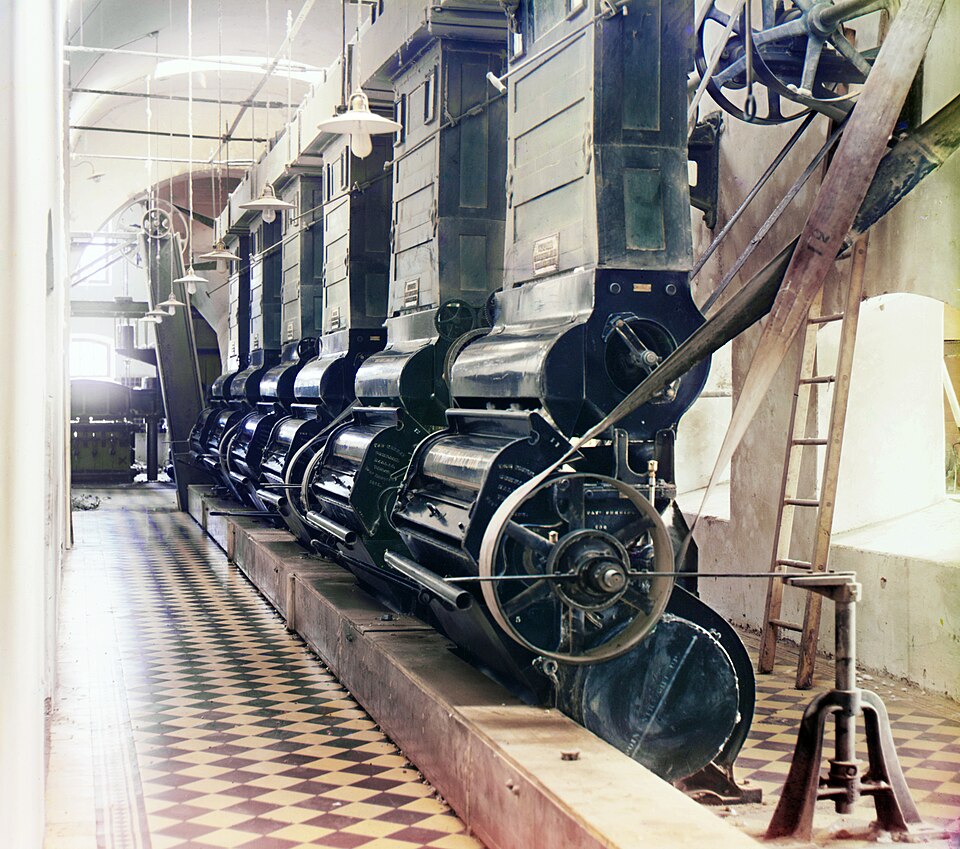
Cotton Ginning Mill (Double-Roller)
A cotton ginning mill separates lint (the spinnable cotton fibre) from cotton seed after harvest. The Indian industry is dominated by double-roller (DR) gins, which are gentler on fibre than saw gins and better suited to the medium- to long-staple Indian cottons.
Function
In a DR gin, two leather-clad rollers rotate in opposite directions; a stationary knife pressed against the rollers grips the fibre while a beater knocks the attached seeds clear. The lint exits at the front and the seed falls into a separate trough. The action preserves staple length, a key fibre-quality parameter.
Design and specifications
Commercial DR gins from Bajaj Steel, Pramukh and other Indian manufacturers deliver lint turnout of approximately 42%. Optimum fibre moisture at the gin stand is 6-7%; drier fibre suffers length damage, wetter fibre lowers cleaning efficiency. Lint is baled to 160-170 kg per bale, with two bales equating to one Indian commercial candy of 356 kg.
Operation
Seed cotton (kapas) is first cleaned of trash in a pre-cleaner, then conveyed to a battery of DR gin stands operated in parallel. Lint is pneumatically conveyed to a press where it is compacted, bound and labelled. Seed flows to oil mills or seed processors. Fibre-quality grading uses the CIRCOT Portable Laboratory Model Gin, a small-batch unit developed by ICAR-CIRCOT for traders, classers and ginners to assess lint outturn and length on short notice.
Subsidy and adoption
ICAR-CIRCOT Mumbai (Central Institute for Research on Cotton Technology) is the apex national institute for cotton-fibre technology. Modernisation of ginning units is supported by the Ministry of Textiles' Technology Mission on Cotton and by state cotton-development schemes.
Related entries
See also: Solar Drying Tunnel, Bull Driven Stone Ghani.
References
- ICAR-CIRCOT Portable Laboratory Model Gin. ICAR-CIRCOT.
- Double Roller Ginning Machine. Pramukh Ginning Machine.