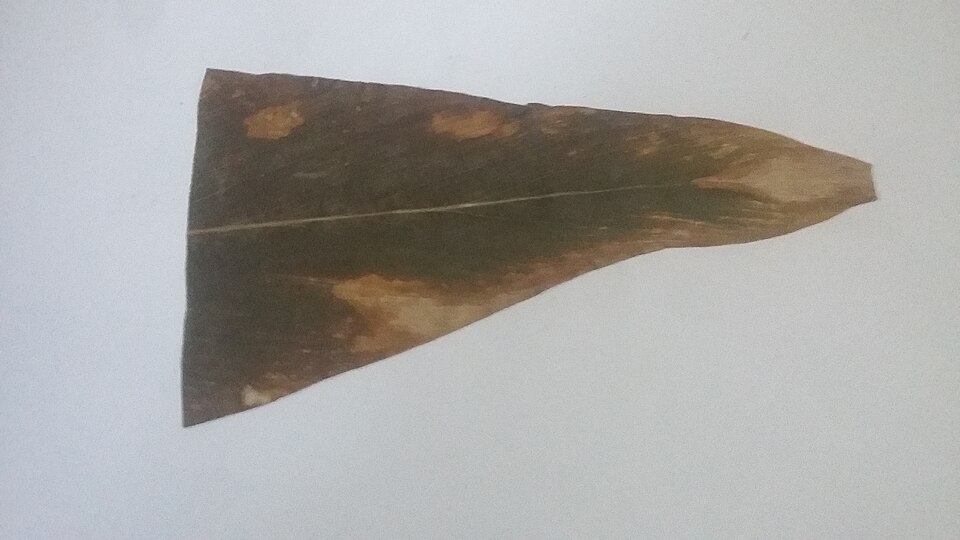
 Photo: Nivetha.atr · CC BY-SA 4.0 · source ↗

Cardamom leaf blight (Phyllosticta / Colletotrichum)
Leaf blight (Chenthal) of cardamom is caused chiefly by Colletotrichum gloeosporioides/fructicola, with annual yield losses of 7-13% under wet-season epidemics in Kerala, Karnataka and Sikkim (large cardamom).
Identification and biology
- Pathogen: Colletotrichum gloeosporioides / C. fructicola
- Yield Loss: 7-13% annual losses
- Fungicide: SAAF (carbendazim+mancozeb) 0.2% most effective; carbendazim 0.1%, hexaconazole
- Epidemiology: occurs in rainy wet season; younger leaves affected first
Management
ICAR-IISR and SAU trials show carbendazim+mancozeb (SAAF) 0.2% and carbendazim 0.1% are the most effective fungicides, followed by hexaconazole. Symptoms begin as yellowish lesions on young leaves coalescing into large blighted areas that give a burnt appearance.
Related entries
See also: Cardamom Small, Cardamom Root Rot, Cardamom Shade Management, Cardamom Stem Borer, Cardamom Curing Grading.
References
- Evaluation of fungicides against cardamom leaf blight. https://www.phytojournal.com/archives/2018/vol7issue3S/PartG/SP-7-3-83-420.pdf
- Preliminary evaluation of cardamom accessions against Chenthal. https://epubs.icar.org.in/index.php/IPPJ/article/view/28129