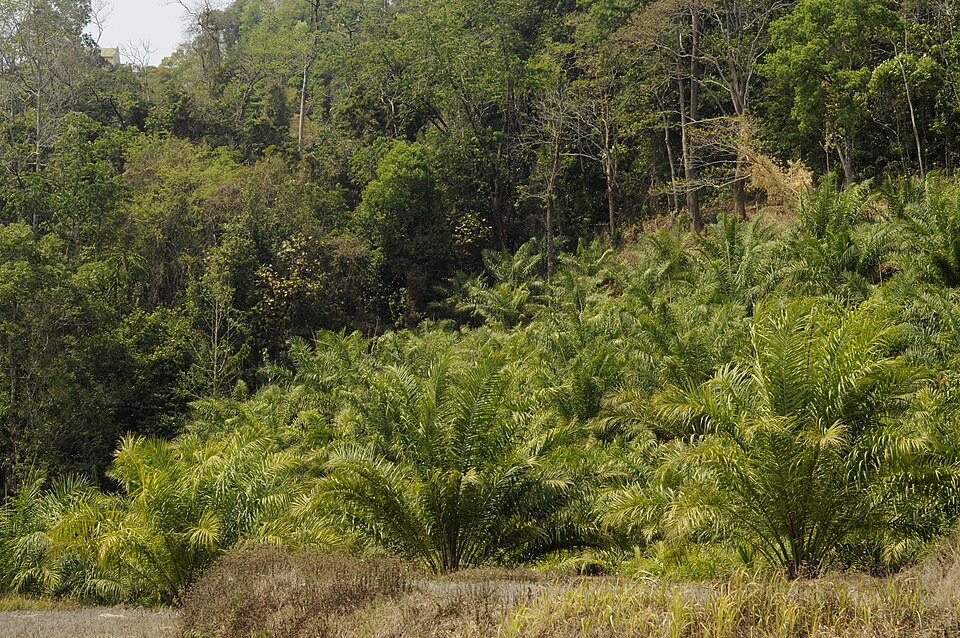
 Photo: T. R. Shankar Raman · CC BY-SA 4.0 · source ↗

Oil palm cultivation (FFB production)
Oil palm (Elaeis guineensis) is cultivated in India for fresh fruit bunches (FFB) that are crushed into crude palm oil and palm kernel oil. The crop is the centrepiece of the National Mission on Edible Oils - Oil Palm (NMEO-OP), launched to reduce India's heavy dependence on edible-oil imports, and is researched and supported nationally by ICAR-IIOPR.
Key characteristics
- Hybrid type: Tenera (Dura x Pisifera), the standard commercial hybrid that combines the high oil yield of Dura with the thin-shell trait of Pisifera
- Lead institute: ICAR-IIOPR, established at Pedavegi (Andhra Pradesh) in 1995 and upgraded to a full institute in 2014
- Yield: best-performing crosses such as NRCOP-9 have recorded around 206 kg FFB/palm/year and around 29.6 t/ha in trials; NRCOP-4 has reached around 23 t/ha by year six
- Scheme: NMEO-OP (Government of India), implemented through state horticulture departments
Cultivation
Tenera seedlings are raised in IIOPR-licensed nurseries and planted at around 9 x 9 x 9 m triangular spacing, giving approximately 143 palms per hectare. Bearing begins from year 3-4 and full production by year 7-8. Drip and basin irrigation are used in non-traditional growing zones such as Andhra Pradesh and Telangana, where evapotranspiration is high. Cocoa can be intercropped under the canopy (Cocoa Cultivation Coconut Intercrop). FFBs are harvested at colour break, every 10-15 days, and transported quickly to processing mills.
Pest and disease profile
The main pests include rhinoceros beetle (which also affects coconut, see Rhinoceros Beetle Palm Pest), bagworms, leaf-eating caterpillars and the invasive rugose spiralling whitefly (Oil Palm Whitefly). Ganoderma basal stem rot is the principal long-term disease threat.
Adoption and use
Andhra Pradesh and Telangana are the leading oil-palm states, with new plantings expanding into north-eastern states under NMEO-OP. IIOPR manages seed nurseries, FFB purchase support and farmer training in coordination with state horticulture departments and processors.
Related entries
See also: Oil Palm Whitefly, Cocoa Cultivation Coconut Intercrop.
References
- ICAR-IIOPR Annual Report 2024. ICAR-IIOPR Pedavegi.
- FAQs in Oil Palm. ICAR-IIOPR.