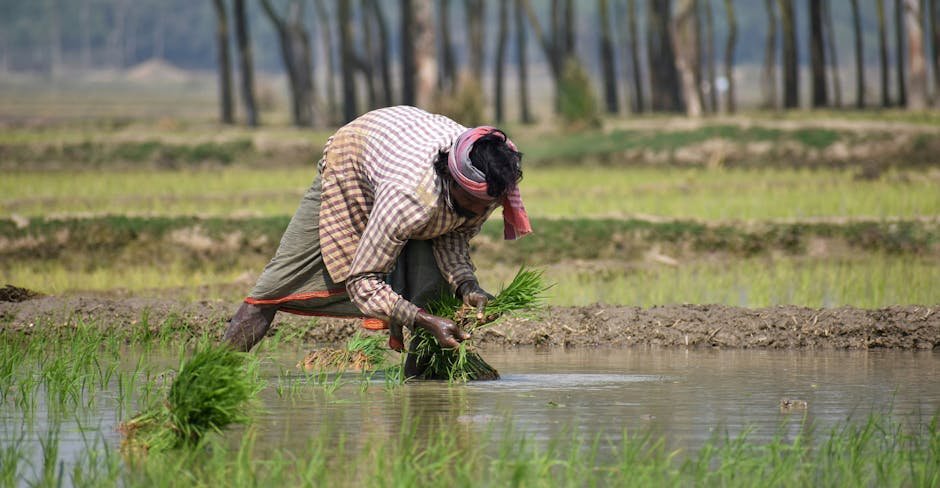
 Photo: Sajal's Gallery · Pexels License · source ↗
Dead furrows for dryland moisture conservation
Dead furrows are deep, open, non-cropped furrows ploughed across the slope of a rainfed field at regular intervals during or shortly after sowing. They function as in-situ rainwater-harvesting trenches that catch runoff inside the same field, reducing soil loss and pushing more rainfall into the root zone of crops such as groundnut, pearl millet (sajja), pulses and castor on shallow red sandy loams.
Principle
On Anantapur-style chalka soils (50-60 cm depth over hard pan) infiltration rates drop steeply after the first 10-15 mm of rain. Excess rain then runs off across the gentle (1-3%) slope, eroding the topsoil and leaving the crop short of moisture in dry spells. A dead furrow intercepts that runoff, ponds it briefly, and gives time for slow lateral infiltration into the inter-furrow strips. Each dead furrow can hold the runoff from one moderate storm without overflowing if it is dug deep enough and laid out at the correct spacing.
Procedure
ICAR-CRIDA and ANGRAU recommend the following spec for rainfed groundnut, pearl millet and redgram:
- Timing: open dead furrows 25-35 days after sowing (DAS), during a routine inter-cultivation pass, before the heavy August-September storms.
- Tool: ridger plough drawn by bullock or tractor; a country plough run twice in the same line also works.
- Spacing: one furrow every 3-6 m across the slope (every 6-12 crop rows, depending on row spacing). Closer spacing on steeper land.
- Cross-section: 25-30 cm wide at the top, 20-25 cm deep, V-shaped.
- Alignment: across the dominant slope, with a slight 0.2-0.4% grade to a grassed waterway so excess water exits safely.
The strips between furrows carry the normal crop; only the furrow itself is non-cropped, and the soil thrown up forms a small ridge on the upslope side that catches additional sheet flow.
When and where it applies
Dead furrows are the recommended in-field water-harvesting technique for: - Shallow red soils of Anantapur, YSR Kadapa, Chittoor, Kurnool, and parts of Karnataka (Chitradurga, Kolar, Tumkur) - Rainfed Spanish-bunch groundnut, pearl millet, foxtail millet, redgram and castor - Fields on 1-3% slope where bunding alone is insufficient
Field trials in Anantapur report 10-25% pod yield increases in groundnut after a single dead-furrow operation in normal monsoon years and substantially higher gains in years with intra-seasonal dry spells.
Limitations
Dead furrows reduce the cropped area by 3-6% depending on spacing — farmers often resist this even when net yields rise. The furrows silt up by harvest and must be re-dug each season. On vertisols and heavy black soils broad bed and furrow is more appropriate; dead furrows in cracking clay can collapse and create gully heads. The technique also requires a clean cross-slope layout that is hard to achieve on small irregularly-shaped holdings.
Related pages
See also: Broad bed and furrow, Raised-bed groundnut, Mulching with organic residue, Anantapur district profile.
Sources
- Conservation furrow for rainfed groundnut. ICAR-CRIDA, Hyderabad.
- In-situ moisture conservation practices. ICAR-Indian Institute of Soil and Water Conservation, Dehradun.
- Dryland watershed manual. ICRISAT, Patancheru.