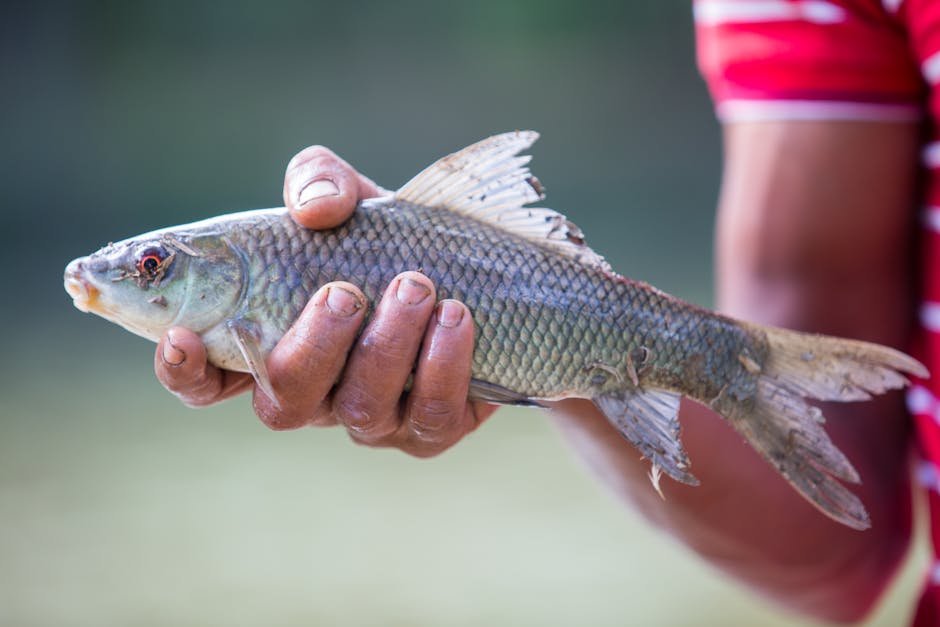
 Photo: Mahmudul Hasan · Pexels License · source ↗
Carp parasites - Argulus and anchor worm (Lernaea)
Argulosis (fish louse) caused by Argulus spp. and lernaeosis (anchor worm) caused by Lernaea spp. are the two most economically important crustacean ectoparasites of cultured Indian Major Carps and exotic carps. Both can cause heavy losses in freshwater ponds, particularly in densely stocked composite culture and in carp hatcheries.
Identification
Argulus (fish louse) is a flattened, disc-shaped crustacean 3-8 mm across, with two prominent suckers, visible to the naked eye attached to the body, fins or gill chambers of fish. Lernaea (anchor worm) is a copepod 10-20 mm long with the anterior end embedded as an anchor in the muscle and a long protruding body with paired egg sacs.
Symptoms
- Argulus: fish flash and rub against pond banks; small red spots and haemorrhages where the parasite attaches; secondary bacterial infection at attachment sites; reduced feed intake; rapid weight loss
- Lernaea: visible thread-like parasite hanging from body, with ulcer at the embedded base; haemorrhage and inflammation; growth retardation in fingerlings and mortality in heavy infestation
Heavy argulosis is associated with mortality of 30-70% in pond carp stocks, especially in summer when parasite generations are short.
Hosts and lifecycle
Both parasites infect rohu, catla, mrigal, common carp, silver carp and grass carp. Argulus has a direct lifecycle: eggs are laid on submerged objects, hatch in 2-4 weeks, larvae find a host within 2-3 days. Lernaea females attach and embed, releasing nauplii into the water that develop through copepodid stages before attaching to a new host.
Management
- Pond preparation: complete drying and sun-exposure of pond beds between cycles; liming at 250-500 kg/ha kills resting eggs of Argulus
- Quarantine: dip new fingerlings in 3% common salt for 2-5 minutes or 500 ppm potassium permanganate for 1-2 minutes before stocking
- Chemical control: argulosis is treated with bath application of dipterex (trichlorfon) at 0.25-0.5 ppm in pond, repeated at 7-day intervals; cypermethrin at 0.01 ppm under veterinary supervision. Lernaea responds to the same treatments
- Biological: stocking insectivorous fish such as snakeheads (in separate enclosures) reduces free-swimming stages
- Bird/snake exclusion (Pond Biosecurity Bird Snake Netting) reduces parasite re-introduction
Related pages
See also: Rohu Labeo Rohita Imc, Catla Catla Indian Major Carp, Mrigal Cirrhinus Mrigala Imc, Carp Disease Dropsy Aeromonas, Fish Pond Construction.
Sources
- Argulosis in Indian aquaculture. ICAR-CIFA Bhubaneswar.
- Crustacean parasites of cultured carps. NACA-FAO.
- Fish health and disease management. Vikaspedia.