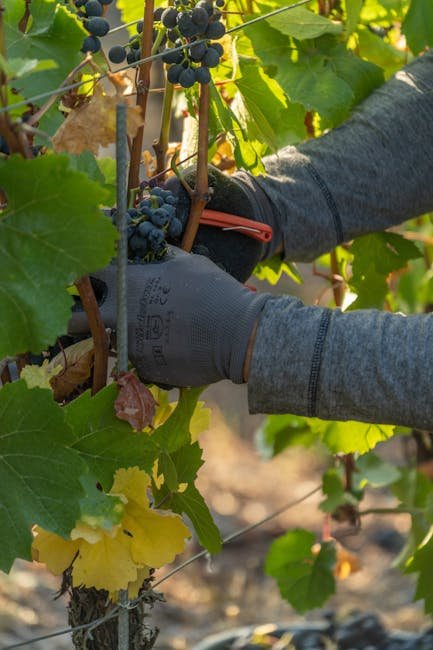
 Photo: Nico Becker · Pexels License · source ↗
Grape foundation and fruit pruning (April / September double-cycle)
The double-pruning calendar used by table-grape growers in Maharashtra, north Karnataka and Andhra Pradesh distinguishes a foundation (back) pruning in April that builds new fruiting wood, and a fruit (forward) pruning in September-October that converts the matured canes into the marketable crop. This entry covers the bud-level decisions and physiological reasoning behind each step. For the cycle-level overview, see Grapes Pruning Back Foreward.
Principle
Indian grape belts are sub-tropical; they lack the cold dormancy that drives a single annual harvest in temperate viticulture. Growers therefore force two separate seasons per vine: a hot vegetative season after April pruning, during which the cane lays down fruitful primordia in dormant buds, and a cool reproductive season after September pruning during which those buds break, flower and fruit. Bud position along the cane matters: in Thompson Seedless (Grapes Thompson Seedless) fruitful buds are concentrated between the 4th and 12th node, which dictates pruning length.
Implementation
- April back (foundation) pruning: canes cut back to one or two buds; whole-vine bud load is set; April pruning is followed by hydrogen cyanamide (Dormex) painting to break dormancy uniformly and to synchronise budbreak.
- April-August foundation phase: new shoots are positioned along the trellis; one or two strong canes per arm are retained and unwanted shoots removed at 6-8 leaf stage; growth regulators (CCC) may be used to harden canes; fertigation pushes vegetative growth.
- August water-stress / hardening: irrigation is cut back for about three weeks to harden canes and to set fruitful primordia in buds.
- September-October forward (fruit) pruning: matured canes cut to leave 8-12 fruiting buds depending on diameter and node fruitfulness; Dormex painting again; flowering follows 25-30 days later.
- October-March fruiting phase: shoot positioning, leaf removal around clusters, GA3 sprays (Grapes Ga3 Thinning Elongation), bunch thinning, deficit irrigation at veraison, harvest.
Where it applies
The protocol is standard for Thompson Seedless and its mutants in the Nashik, Sangli, Solapur, Pune, Satara and Bijapur belts. For seeded pandal cultivars such as Anab-e-Shahi (Grapes Anab E Shahi), single annual pruning is more common.
Limitations
The double-cycle is labour and input intensive. Bud necrosis, poor cane maturity, unseasonal rain at either pruning, or wrong calculation of bud load can all sharply cut yields. ICAR-NRCG emphasises plant-by-plant cane diameter assessment before deciding fruit pruning length.
Related pages
See also: Grapes Pruning Back Foreward, Grapes Thompson Seedless, Grapes Ga3 Thinning Elongation, Grapes Bagging Trellis Protected.
Sources
- Training and Pruning in Grapes. ICAR-NRC Grapes Technical Bulletin 9.
- Fruit Pruning in Grapes. ICAR-NRC Grapes Technical Bulletin 14.