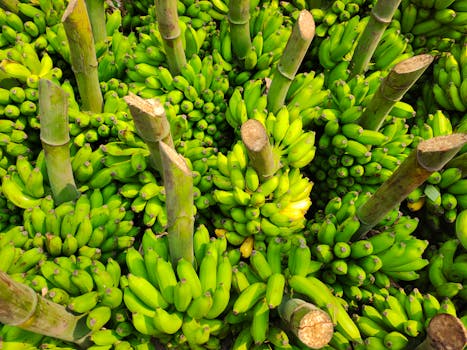
 Photo: Sanjay Sharma · Pexels License · source ↗
Banana bunch staking
Banana bunch staking is the orchard practice of propping a banana plant at and after bunch emergence to prevent the heavy bunch from toppling the shallow-rooted pseudostem in wind or rain. It is a standard recommendation in the banana package of practices issued by TNAU and the National Horticulture Board.
Principle
Banana is a shallow-rooted, herbaceous monocot whose root system does not anchor a bunch-laden plant against wind speeds above about 30 km/h. Once the bunch emerges and begins to fill, the plant's centre of gravity rises sharply, and unsupported plants lodge with total loss of the bunch and frequent damage to neighbouring plants.
Implementation
Two bamboo or casuarina poles, each typically 3-4 years in service life, are placed against the peduncle on opposite sides to form a triangle with the pseudostem and tied at the top. Coir, jute or polythene wire is used for tying. Some growers use a single inclined pole tied just below the bunch. Staking is begun at bunch emergence and maintained until harvest.
Adoption context
Bamboo is the most common material in south Indian commercial plantings; casuarina is preferred where it is locally cheaper. The practice is universal in high-yield Cavendish G9 plantings (Banana G9 Tissue Culture) where bunches can weigh 30 kg or more, and is also standard for ABB types such as Karpooravalli (Banana Karpura Sugandham).
Limitations
Bamboo poles add a recurring input cost and require labour-intensive installation; in cyclone-prone coastal belts even staked plants can lodge. Some growers reduce risk by using shorter cycles and selecting more wind-tolerant cultivars.
Related entries
See also: Banana G9 Tissue Culture, Banana Karpura Sugandham, Banana Residue Mulching.
References
- Banana Intercultural Operations. National Horticulture Board.
- Banana Cultivation. TNAU Expert System.