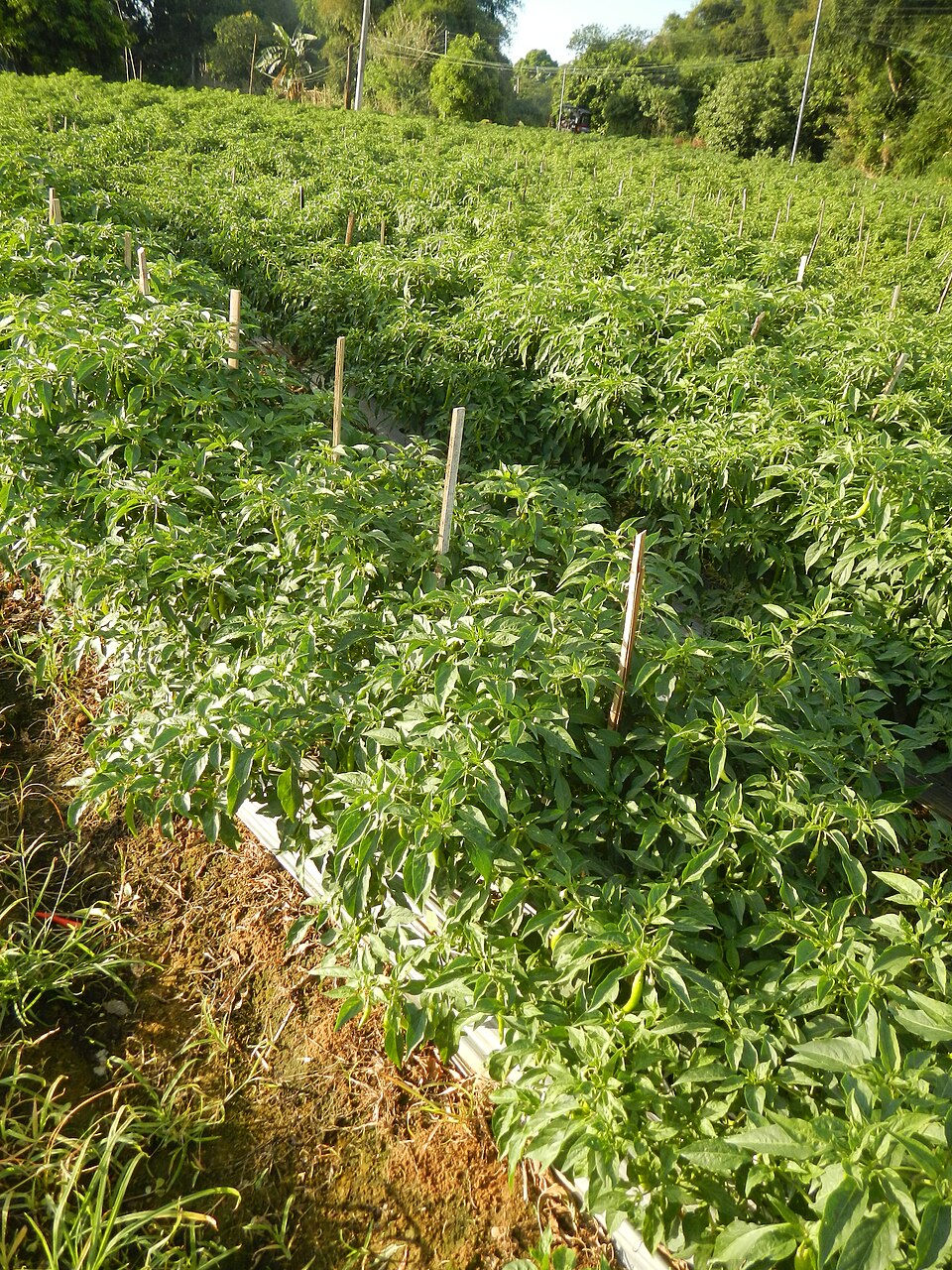
 Photo: Judgefloro · Public domain · source ↗

Chilli spray schedule (first spray to second flush)
TNAU's AESA-based IPM schedule for chilli prescribes an activity-wise plant-protection calendar from nursery to harvest. It is the formal Indian extension recommendation for combining biocontrol, cultural and chemical inputs across the chilli crop cycle.
Principle
The schedule integrates soil-borne, sucking, chewing and foliar-disease management into approximately eight sprays placed from 10 to 120 days after transplanting (DAT). Sequencing is built around insect-pest life cycles and disease infection windows, with the goal of preserving chemistry rotation and minimising residue.
Implementation
The framework combines:
- Soil-borne baseline — neem cake plus Trichoderma viride at transplanting against soil-borne diseases (Disease Chilli Root Stem Rot, Chilli Damping Off Nursery Rot)
- Sucking-pest spray — 15-20 DAT, targeting whitefly, aphids and jassids (Pest Sucking Pests Chilli)
- Mid-stage combos — sucking-plus-chewing sprays through the vegetative-to-flowering window, addressing caterpillars (Pest Caterpillars Chilli) and the thrips-mite complex (Pest Thrips Parvispinus Black Thrips, Pest Mites Chilli)
- Disease window — captan / difenoconazole sprays from flowering against fruit anthracnose (Disease Chilli Dieback Anthracnose)
- Second-flush stage — PGR (NAA) and micronutrient sprays at 120-140 DAT to retain the second flush of flowers (Disorder Chilli Flower Bud Drop)
The protection calendar is paired with the staged NPK fertiliser schedule (Practice Chilli Fertilizer Schedule) and the raised-bed nursery protocol (Practice Chilli Nursery Raising).
Adoption context
The TNAU and NIPHM schedules underpin extension-system recommendations across south Indian chilli districts. Private hybrids — BASF Armour (Chilli Basf Armour), Syngenta HPH 2043 (Chilli Syngenta Hph 2043) — are typically sold with rider notes pointing to this calendar.
Limitations
The eight-spray framework is a template, not a prescription: dose, molecule choice and timing must be adjusted to local pest pressure, varietal sensitivity (HPH 2043 is more thrips/mite-sensitive) and weather. Resistance management requires strict rotation across modes of action.
Related entries
Practice Chilli Nursery Raising, Practice Chilli Fertilizer Schedule, Pest Thrips Parvispinus Black Thrips, Pest Mites Chilli, Disease Chilli Dieback Anthracnose
References
- IPM Schedule for vegetables (chilli). TNAU.
- AESA-based IPM Chillies / Capsicum. NIPHM.