 Photo: Klever · Public domain · source ↗

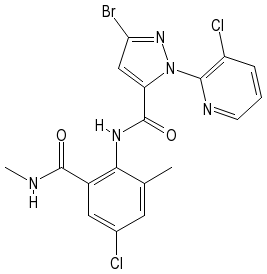
Chlorantraniliprole
Chlorantraniliprole is the foundational anthranilic-diamide insecticide developed by DuPont (now FMC), launched in 2007 under the active brand Rynaxypyr. It is one of the most important molecules in modern lepidopteran pest management worldwide.
Composition / Active ingredient
- Active ingredient: Chlorantraniliprole
- Indian formulations: 18.5% SC (Coragen), 0.4% GR (Ferterra), 35% WG (various generic), plus pre-mixes with lambda-cyhalothrin (Ampligo) and thiamethoxam (Voliam Flexi)
- Chemical class: Anthranilic diamide
Mode of action
Chlorantraniliprole binds and locks open the insect ryanodine receptor, causing uncontrolled release of calcium ions from intracellular stores. Muscle paralysis and feeding cessation occur within hours, with death following in 2-4 days. It is the lead molecule of IRAC Group 28 (ryanodine receptor modulators), and selective for insect over mammalian receptors by a factor of several thousand.
Target use and dose
The molecule is broadly registered for:
- Paddy: yellow stem borer, leaf folder
- Cotton: bollworms (Helicoverpa, Pectinophora), Spodoptera
- Vegetables and pulses: fruit borer, pod borer, Spodoptera, diamondback moth
Standard foliar dose with the 18.5% SC is 60 ml/acre; the 35% WG form is used at proportionally lower rates. Ferterra GR is broadcast at 4 kg/acre.
Safety and regulatory status
Chlorantraniliprole has a favourable safety profile for mammals, fish and pollinators, but its widespread use has selected for resistant Plutella xylostella (DBM) and Spodoptera frugiperda populations in some regions. Resistance management requires rotation with unrelated MoAs such as Broflanilide Exponus (Group 30), Emamectin Benzoate (Group 6) and spinosyns.
Related entries
See also: Coragen Chlorantraniliprole, Chlorantraniliprole Coragen Ferterra, Ampligo, Cyantraniliprole Benevia, Broflanilide Exponus.
References
- Coragen Insecticide. BigHaat.
- Chlorantraniliprole risk assessment in paddy ecosystem. Scientific Reports (2023).