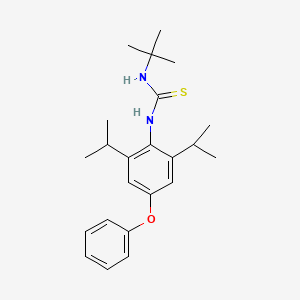
 Photo: Diafenthiuron · Public domain · source ↗

Diafenthiuron (Syngenta Pegasus)
Diafenthiuron is a thiourea-derivative insecticide-acaricide marketed in India as Syngenta Pegasus 50% WP. It is a "pro-insecticide" — its active form is generated only in the field after sunlight or insect P450 enzymes convert it.
Composition / Active ingredient
- Active ingredient: Diafenthiuron
- Formulation: 50% WP (wettable powder)
- Chemical class: Thiourea derivative
Mode of action
The parent diafenthiuron is converted by UV light and insect cytochrome P450 oxidases to its active carbodiimide metabolite, which irreversibly inhibits mitochondrial ATP synthase (complex V). It is classified under IRAC Group 12A (inhibitor of mitochondrial ATP synthase). Insects show reduced activity within hours of ingestion or contact, followed by paralysis and death; the molecule has translaminar but not systemic activity.
Target use and dose
CIBRC-labelled uses include:
- Cotton, chilli, vegetables: whiteflies, aphids, thrips, jassids
- Mites: red spider mite, two-spotted mite
- Cabbage: diamondback moth (DBM)
- Cardamom: capsule borer
The combination with emamectin benzoate (see Input Emamectin Diafenthiuron) is widely used in chilli and cotton for simultaneous sap-sucker plus caterpillar cover.
Safety and regulatory status
Diafenthiuron's distinct mode of action makes it a key resistance-management partner for neonicotinoid programmes (rotation with Acetamiprid, Thiamethoxam Actara, Flupyradifurone Gracia) and for whitefly. It is moderately toxic to mammals and label intervals must be observed; pre-harvest interval varies by crop.
Related entries
See also: Input Emamectin Diafenthiuron, Acetamiprid, Thiamethoxam Actara, Flonicamid Ulala, Spirotetramat Movento.
References
- Pegasus. Syngenta India.
- Syngenta Pegasus — Diafenthiuron 50% WP. BigHaat.