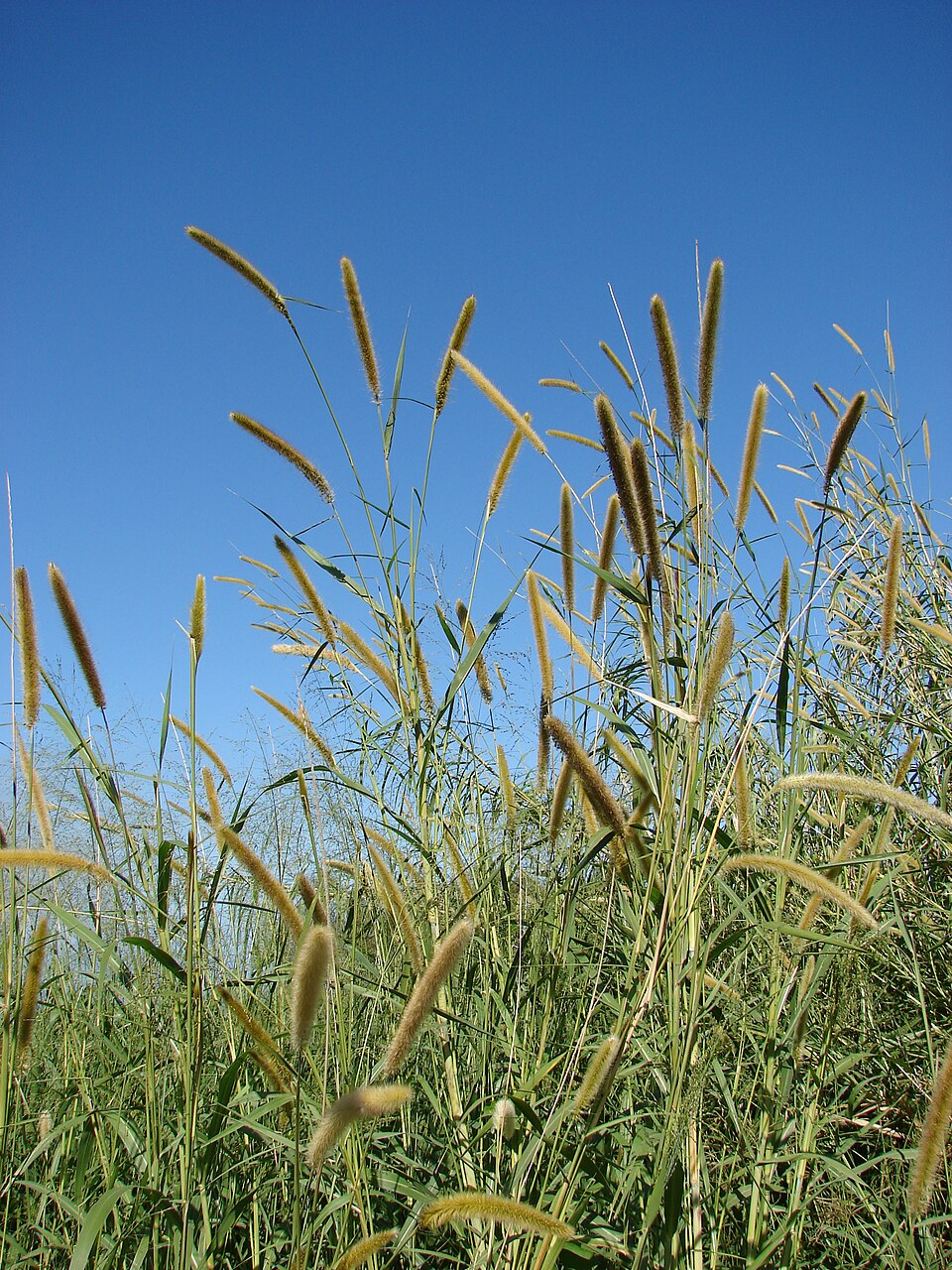
 Photo: Forest & Kim Starr · CC BY 3.0 · source ↗

Super Napier (Pakchong) fodder
Super Napier, marketed in India as Pakchong 1, is a hybrid forage grass developed in Thailand by Dr Krailas Kiyothong of the Pakchong Animal Nutrition Research and Development Centre. It is an interspecific cross between elephant grass (Pennisetum purpureum) and pearl millet (Pennisetum glaucum), bred for higher leaf-to-stem ratio and substantially higher crude protein than older Napier hybrids. The cultivar has spread rapidly across South Indian dairy belts since the mid-2010s through stem-cutting based propagation.
Key characteristics
- Origin: Pakchong, Thailand.
- Parentage: Pennisetum purpureum x Pennisetum glaucum interspecific hybrid.
- Growth habit: tall perennial bunch grass reaching 2-3 m, with a soft, leafy canopy and reduced lignin content.
- Crude protein: 16-18% — markedly above the 8-10% range of older bajra-Napier hybrids (Bullet Napier And Hybrids).
- Stand life: 6-8 years.
- Biomass yield: 180-200 tonnes of green fodder per acre per year, harvested across 7-8 cuts.
Cultivation
Propagation is vegetative, by stem cuttings (two-to-three-node setts) planted on ridges or in pits at approximately 25,000 plants per hectare. The crop responds strongly to nitrogen fertilisation and to a cleaning irrigation after each cut. The first cut is taken around 90 days after planting; subsequent cuts follow every 45-60 days. Cutting height of about 15 cm above ground preserves the basal buds and supports stand longevity. Replanting from fresh setts is recommended at the end of the productive cycle to restore vigour.
Pest and disease profile
Super Napier is broadly hardy but susceptible to foliar diseases such as Helminthosporium leaf spot and to stem-borer attack under high humidity. Clean planting material, balanced fertilisation and timely cuts are the principal defences.
Adoption and use
The grass is fed chopped at 20-30 kg per adult dairy animal per day. Its high crude-protein content allows farmers to reduce the protein density of the concentrate ration (Concentrate Feed Mix Dairy) and to lean more heavily on green fodder. It is widely planted on HF-crossbred (Holstein Friesian Crossbred Cow), Jersey-crossbred (Jersey Crossbred Cow) and Murrah buffalo (Murrah Buffalo) dairy farms in Tamil Nadu, Andhra Pradesh, Telangana, Karnataka and Kerala, often alongside maize fodder (Maize Fodder) for the silage cycle and hedge lucerne (Hedge Lucerne Velimasal) for additional protein.
Related entries
See also: Bullet Napier And Hybrids.
References
- Super Hybrid Napier Grass — Pakchong. The Organic Farmer.
- Super Napier Pakchong 1 Cultivation Guide. Agropests.