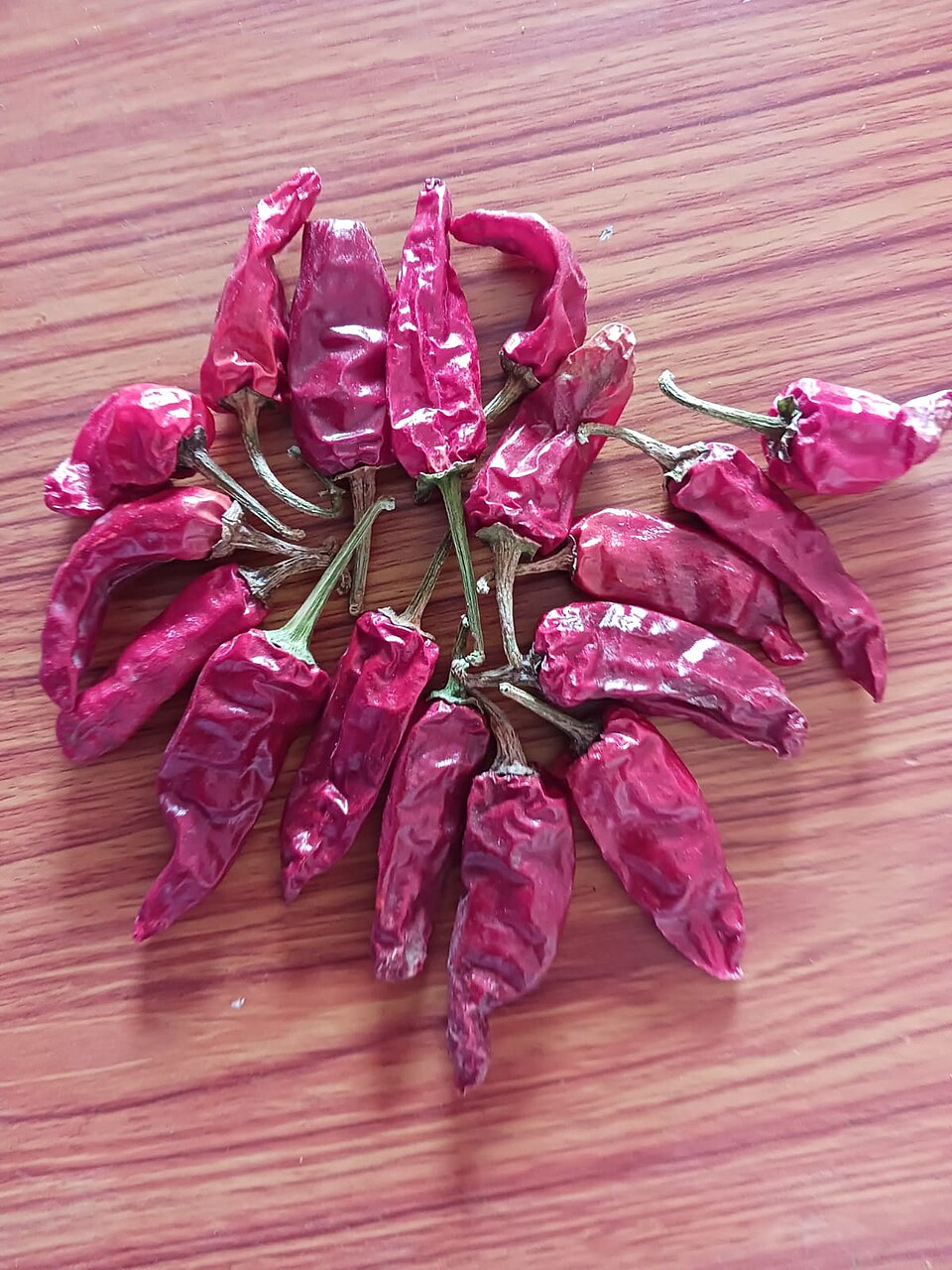
 Photo: Dr. Narayan Chindhuji Lambat · CC0 · source ↗

Chilli picking, sun-drying and tarpaulin practice
Spices Board of India and ICAR-CIPHET document chilli post-harvest as the high-loss stage of the value chain, with annual losses of 25-35% where drying is mismanaged. The standard practice for export-grade dry pods is sun-drying on tarpaulin or concrete yards to a target moisture of 9-10%.
Principle
Drying reduces pod moisture to a level (9-10%) at which storage fungi and anthracnose (Disease Chilli Dieback Anthracnose) cannot develop, while preserving capsanthin / capsaicin content. Cold storage at 4-7 deg C is used for off-season holding of dried pods to preserve colour value.
Implementation
- Picking — harvest fully red ripe pods
- Sun-drying — 8-15 days on tarpaulin or concrete yard
- Mechanical drying — approximately 54.5 deg C for 2-3 days as an alternative to sun-drying
- Target moisture — 9-10%
- Cold storage — 4-7 deg C for colour preservation
- Sorting and packing — to BIS-grade specifications
- Finance — warehouse-receipt financing through NABARD-linked warehouses
Adoption context
The protocol underpins the export-oriented Guntur trade (Chilli Guntur Sannam) and the Teja-segment dry-pod supply chain (Chilli Teja Segment). It is equally important for the high-value Byadgi oleoresin-feed chain (Chilli Byadgi Segment), where ASTA colour preservation drives buyer prices.
Limitations
Sun-drying is labour-intensive and weather-dependent; tarpaulin practice provides only partial protection against rain re-wetting during unseasonal showers. Mechanical drying at 54.5 deg C requires capital investment that limits adoption to large producers and processors.
Related entries
Chilli Guntur Sannam, Chilli Teja Segment, Chilli Byadgi Segment, Disease Chilli Dieback Anthracnose
References
- Post-Harvest Improvement Programme. Spices Board India.
- Post-Harvest Profile of Chilli. DMI Agmarknet.
- Post-harvest profile and processing of dried red chillies. Journal of Food Science and Technology (Springer), 2022.