 Photo: MB-one · CC BY-SA 4.0 · source ↗
.jpg)
Tractor-Drawn Seed Drill
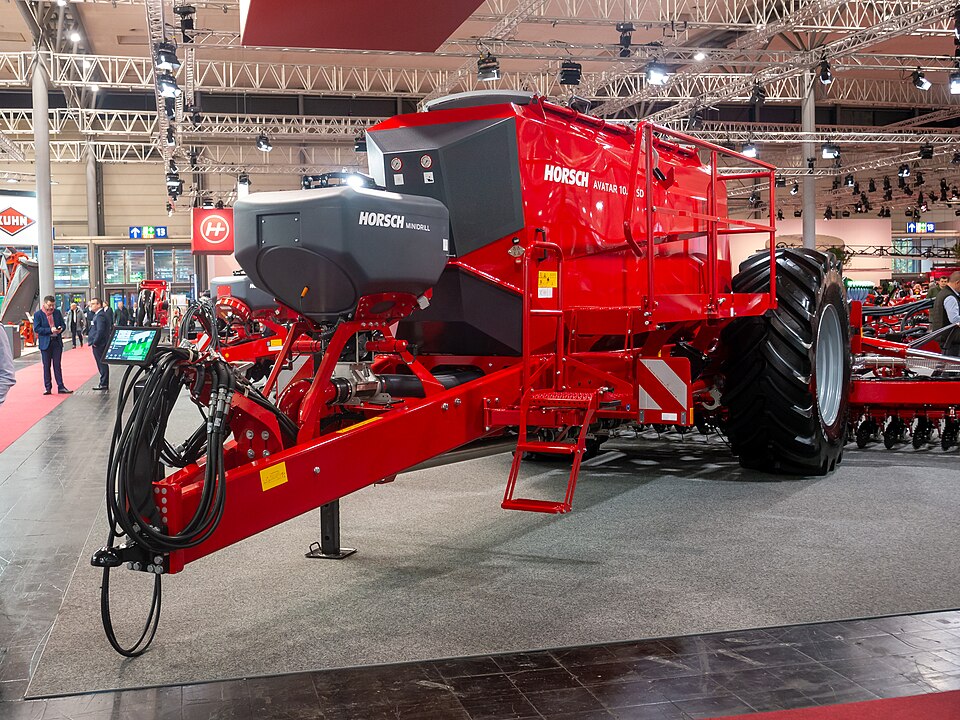
A tractor-drawn seed drill, called gorru in Telugu and bukhar in some northern dialects, is a multi-row implement with a seed hopper, ground-wheel-driven metering and shoe-type furrow openers. It places seed at uniform depth and row spacing for crops including maize, cotton, pulses, soybean and wheat.
Function
The ground wheel rotates fluted rollers or inclined plates inside the seed hopper, dropping seed at a metered rate into seed tubes that lead to the furrow openers. The opener cuts a shallow furrow, the seed drops in, and a covering chain or press wheel closes the furrow behind. Compared with broadcast sowing, the drill cuts seed rate, improves stand uniformity and establishes plants in straight rows that allow mechanical inter-cultivation.
Design and specifications
ICAR-CIAE Bhopal and the AICRP-FIM partner State Agricultural Universities (PAU, GBPUAT, TNAU) have standardised 9- and 11-row designs. Field capacity is typically 0.4-0.65 ha/hour with field efficiency around 84%. Row spacing depends on crop: 18-25 cm for wheat and pulses, 45-60 cm for cotton.
Operation
The drill mounts on the tractor's three-point linkage and is operated after seedbed preparation with a Rotavator or Disc Rotavator. Seed rate is set by selecting the appropriate fluted-roller exposure and gear ratio. The drill is the recommended replacement for broadcast sowing and is a key implement for conservation-agriculture and reduced-tillage systems.
Subsidy and adoption
The seed drill is on the SMAM subsidy list with 40-50% individual-farmer assistance, and is widely included in CHC and Farm Machinery Bank equipment baskets (Agri Machinery Dealer Ecosystem).
Related entries
See also: Twin Box Seed Drill, Drum Seeder Paddy, Hand Push Seeder, Paddy Transplanter, Rotavator.
References
- Seed-cum-Fertilizer Drill. ICAR-CIWA.
- Sowing Methods - Seed Drills. TNAU Agritech, Lecture 8.