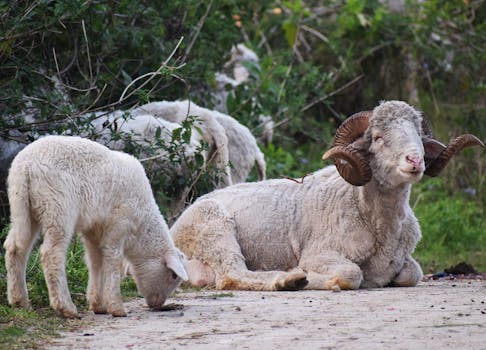
 Photo: Rajesh S Balouria · Pexels License · source ↗
Ram lamb fattening for the Bakrid market
Ram lamb fattening is an intensive stall-feeding system in which young male sheep (and goats) are confined and fed a concentrate-rich ration to reach a heavy slaughter weight several weeks earlier than under traditional grazing. It is timed to deliver finished animals into the religious festival peaks — Bakrid (Eid al-Adha), Sankranti and Dasara — when ram-lamb prices in southern Indian markets are at their seasonal high.
Principle
A stall-fed lamb is finished on a high-energy, balanced ration that maximises average daily gain and produces a heavier carcass with a more desirable lean-to-fat ratio than a free-grazing animal of the same age. ICAR-Central Sheep and Wool Research Institute (CSWRI), Avikanagar, has documented that stall-feeding shortens the days to a given market weight, raises gross carcass yield and improves financial returns when commons are over-grazed (the desired norm is approximately 1.3 ha per Animal Consumption Unit, while the actual figure is closer to 0.77 ha per ACU in many south Indian tracts).
Implementation
Lambs are inducted into the feedlot at 3-6 months of age, weighing 12-18 kg, often purchased from migratory shepherds (Migratory Sheep Grazing) of breeds such as Nellore (Nellore Sheep) or Deccani. Goats including Osmanabadi Goat are fattened on similar lines. Daily ration combines green fodder, dry roughage and 300-500 g of concentrate per animal, scaled with weight. Lambs are dewormed on entry, vaccinated against PPR, FMD, enterotoxaemia and sheep pox (Small Ruminant Vaccination Schedule) and housed in clean elevated or kutcha sheds. Pen sizes are kept small to reduce activity and channel energy into weight gain. The fattening cycle runs 60-120 days, ending two to three weeks before the target festival date when sale weight of 25-35 kg is reached.
Adoption context
The practice is widespread across Andhra Pradesh, Telangana, Karnataka, Maharashtra and Tamil Nadu, where festival demand for whole, intact male animals supports a strong price premium. Feedlot operators source lambs from migratory flocks, integrate small intensification into the existing pastoralist economy, and add value through structured nutrition and health management.
Limitations
The system depends on a procurable supply of weaner lambs and on a clearly forecast festival price spike. Disease introductions from purchased lambs are the largest single risk; isolation pens, deworming on entry, and complete vaccination are essential. Bluetongue (Bluetongue Sheep) outbreaks in the procurement tract can disrupt supply. Elevated slatted-floor sheds (Elevated Goat Sheep Shed) reduce parasitic and respiratory losses in humid finishing periods.
Related entries
See also: Nellore Sheep.
References
- Stall Feeding of Sheep and Goats. Indian Journal of Animal Sciences.
- Ram-Lamb Fattening. vikaspedia.
- Animal Nutrition. ICAR-Central Sheep and Wool Research Institute, Avikanagar.