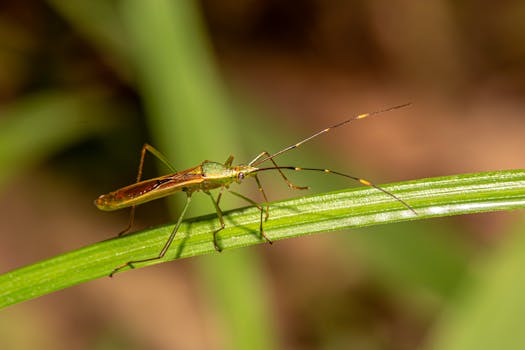
 Photo: Erik Karits · Pexels License · source ↗
Asian rice gall midge (kuda eega)
The Asian rice gall midge, Orseolia oryzae (Wood-Mason), known in Telugu as kuda eega, is a cecidomyiid fly whose larvae are an important tiller-stage pest of rainfed and irrigated rice across South and Southeast Asia.
Identification and symptoms
Larvae enter the developing tiller and feed within the apical meristem. The growing point is converted into a hollow, pale, tubular gall - the diagnostic 'silver shoot' or 'onion shoot' - that protrudes from the tiller. Galled tillers are stunted, do not produce a panicle and are lost to yield. Affected fields show patches of slender, pale tubes rising above the canopy.
Host crops and life cycle
Orseolia oryzae is essentially monophagous on cultivated rice with carry-over on grassy hosts. Adults are weak-flying, short-lived midges that lay eggs at the leaf sheath base. The pest is most damaging at the active tillering stage on transplanted (Transplanting Paddy) and rainfed lowland rice during the kharif/monsoon. Multiple biotypes have been characterised, and resistance breakdown by new biotypes is a recurring problem.
Damage and economic impact
Because galled tillers never bear grain, losses scale directly with infestation. Endemic tracts in eastern and southern India routinely report 10-30% productive tiller loss in susceptible varieties, with much higher localised damage in outbreak years.
Management
- Host plant resistance is the cornerstone of management. Telangana releases including Knm 1638 (gall-midge resistant), Jgl 24423 and Jgl 28545 carry resistance or tolerance.
- Cultural: avoid late and staggered planting in endemic areas; clean bunds of Echinochloa and wild rice.
- Chemical: granular insecticides applied at transplanting (carbofuran historically, increasingly replaced by safer chemistries) can suppress early infestations.
- Screening: ICAR-IIRR has published a standardised phenotyping protocol (2021) for evaluating resistance, supporting downstream variety development.
Related entries
See also: Knm 1638, Jgl 24423, Jgl 28545, Stem Borer Paddy, Yellow Stem Borer Paddy, Brown Planthopper Paddy.
References
- Improved phenotyping procedure for evaluating resistance in rice against gall midge. Plant Methods (ICAR-IIRR), 2021.
- Rice Gall Midge: Orseolia oryzae. CABI Plantwise.