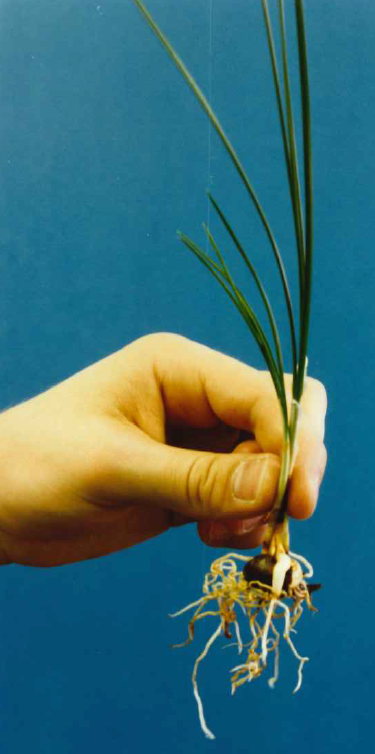
 Photo: Fred Souret · CC BY-SA 4.0 · source ↗

Kashmir saffron corms
Saffron (Crocus sativus) is the source of the dried red stigmas marketed as the spice saffron. In India, commercial saffron cultivation is concentrated almost entirely in the Kashmir Valley, with Pampore in Pulwama district as the primary belt. The crop is propagated vegetatively from corms; planting material from this region is recognised by the International Indo-Kashmir Saffron Trading Centre (IIKSTC) Pampore quality norms as Grade-1.
Origin and distribution
- Primary region: Pampore plateau, Pulwama district, Kashmir Valley.
- Other minor production: Kishtwar district (Jammu region) and high-altitude pockets of Himachal Pradesh and Uttarakhand.
- Propagule: corms (vegetative), planted in late summer for autumn flowering.
The Pampore saffron belt holds Geographical Indication status, and the corms produced there are the foundation planting material for Indian commercial production.
Morphology and physiology
The crop is a sterile triploid that does not produce viable seed; multiplication is therefore exclusively by daughter corms produced underground each season. Flowering occurs in a narrow autumn window in November-December; the rest of the year the plant is dormant or vegetative. A single planting establishes for 10-15 years before corm size decline forces replanting.
Performance and propagation
Corm size at planting strongly influences flower number in the first flowering season. Larger mother corms produce both more flowers and a greater number of daughter corms. Traditional field cultivation depends on autumn temperature and rainfall, and yields have been declining over recent decades due to climate variability and corm-borne disease. SKUAST-Kashmir piloted indoor saffron farming under controlled temperature, humidity and light using Pampore-sourced corms in a NABARD-funded three-year project (2021-2024), as one approach to stabilise yield and quality.
Adoption context
Indian saffron output remains a small fraction of global production, which is dominated by Iran. Kashmir saffron commands a price premium for its long red stigma, high crocin content and protected origin. Corms are supplied through SKUAST-Kashmir, the J&K Department of Agriculture and certified Pampore growers, and are the basis of all new and indoor saffron plantings.
Related entries
See also: Kadiyam Nursery Belt, Fruit Research Station Sangareddy, Grafted Brinjal Seedlings.
References
- Indoor Saffron Farming Offers Hope Amidst Declining Saffron Production. Mongabay India.
- Saffron Cultivation in Kashmir. Global Science Books.