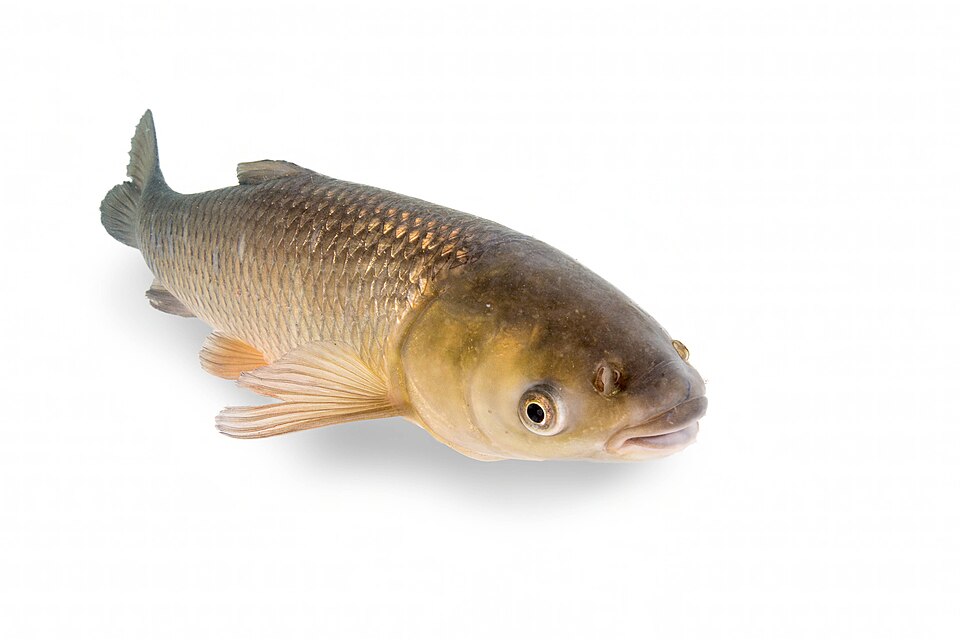
 Photo: Hagerty, Ryan/USFWS · Public domain · source ↗

Grass carp (Ctenopharyngodon idella)
Grass carp (Ctenopharyngodon idella) is a large herbivorous freshwater carp native to East Asia and introduced to Indian aquaculture as one of the exotic carps used in composite fish culture. It is one of the world's most cultivated aquaculture species, valued both as table fish and as a biological agent for aquatic weed control.
Key characteristics
- Family: Cyprinidae
- Feeding habit: herbivore, feeding on submerged macrophytes, fresh grass, paddy straw and duckweed
- Polyculture niche: macrophyte-feeder, typically 10-15% of the stocking in a six-species carp system
- Growth: reaches table size (1-1.5 kg) in about a year under good management
Cultivation
In India grass carp is stocked alongside catla, rohu, mrigal and (in six-species systems) silver carp and common carp (Carp Polyculture Pond). It is fed directly with fresh grass, paddy straw, hydrilla and other aquatic vegetation rather than pellet feed, which lowers feed cost and also serves to clear weed-choked ponds. Fingerlings are sourced from accredited freshwater hatcheries (Fingerling Seed Quality) and stocked in standard earthen ponds (Fish Pond Construction).
Health and ecological profile
Grass carp can carry typical freshwater carp parasites and bacterial infections; pond hygiene and quarantined seed sourcing limit losses. Because the species can damage native macrophyte communities if it escapes into open waters, stocking in unrestrained reservoirs is discouraged in many jurisdictions.
Adoption and use
ICAR-CIFRI Barrackpore began evaluating grass carp from 1971 under the All India Coordinated Research Project on Composite Culture of Indian and Exotic Fishes, after which the species was incorporated into the recommended polyculture package. India, alongside Bangladesh and Iran, has used it for both pond aquaculture and weed control. FAO records the species among the world's most cultivated aquaculture species, with global use across more than 80 countries.
Related entries
See also: Carp Polyculture Pond, Fish Pond Construction, Fingerling Seed Quality, Pond Biosecurity Bird Snake Netting, Bamboo Fish Traps.
References
- Ctenopharyngodon idella. FAO Cultured Aquatic Species fact sheet.
- Importance of Grass Carp for Controlling Aquatic Vegetation. IntechOpen.
- On the growth of grass carp in composite fish culture at Kalyani. ScienceDirect.