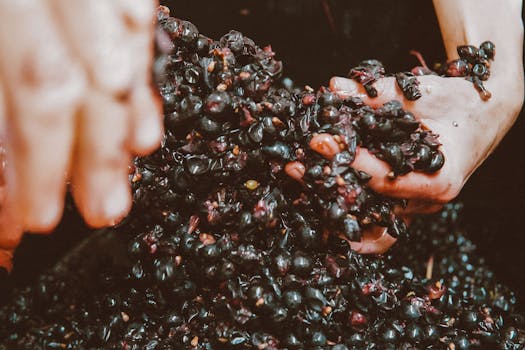
 Photo: Grape Things · Pexels License · source ↗
Jamun juice processing (no-additive bottling)
Jamun (Syzygium cumini) is a deep-purple fleshy fruit grown commercially in pockets of Maharashtra, Gujarat and southern India. Its short shelf life and high tannin content have led to substantial interest in juice processing as a value-addition pathway, and CSIR-CFTRI Mysore has developed protocols for industrial-scale jamun juice and ready-to-serve (RTS) beverage manufacture.
Principle
Jamun pulp contains sugars, organic acids, anthocyanins and tannins. Mild heat treatment denatures enzymes that otherwise cause browning, while pasteurisation eliminates the spoilage microbiota. Optional preservatives or pectin-clarification steps further extend shelf life of bottled juice.
Implementation
A typical CFTRI-aligned process flow is:
- Fruits are cold-stored at around 9-10 deg C and washed.
- Pulping equipment separates pulp from seed; mild heat is applied to soften pulp.
- Pulp passes through a stainless-steel food-grade strainer.
- Juice is extracted with a hydraulic or screw press; optional pectinase clarification follows.
- Juice is pasteurised at approximately 90 deg C for 5 minutes.
- Sodium benzoate may be added at 200-600 ppm.
- Juice is filled hot into pre-sterilised glass or PET bottles, sealed and cooled.
Adoption context
Smaller processors operate "no-additive" lines that rely on pasteurisation and cold-chain alone, while larger units use chemical preservatives for ambient-stable shelf life. Both pathways draw on dedicated jamun varieties such as Konkan Bahadoli (Jamun Konkan Meladonia), which offers high pulp recovery and bold fruits suited to processing.
Limitations
Jamun's high tannin level makes bitter notes a recurring quality issue; pH adjustment and blending with sugar syrup or other juices are common workarounds. Sediment and colour drift on storage also require careful control of pectin and oxygen exposure.
Related entries
See also: Jamun Konkan Meladonia.
References
- Jamun Products Technology. CSIR-CFTRI Mysore.
- Processing of jamun fruit into RTS beverage. Khurdiya and Roy, Semantic Scholar.