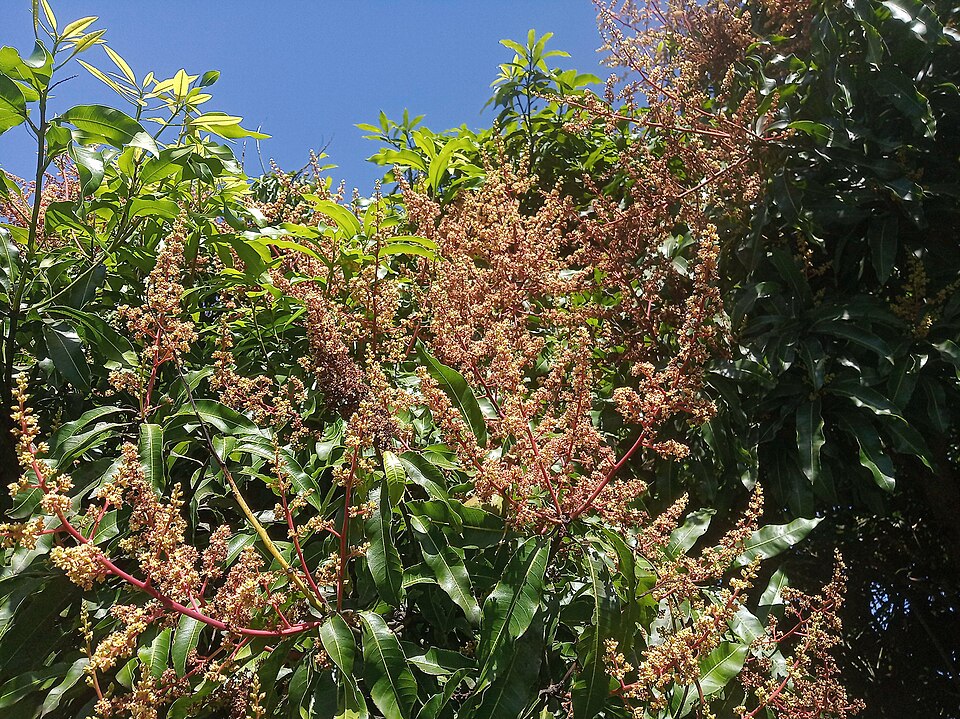
 Photo: Filo gèn' · CC BY-SA 4.0 · source ↗

Mango flowering management and flower drop prevention
Flowering management in mango combines plant growth regulators (PGRs), nutrient sprays and canopy preparation to bring the orchard into uniform bloom and reduce the heavy flower and young-fruit drop typical of the crop. The two principal chemical tools are potassium nitrate (KNO3) and the gibberellin-synthesis inhibitor paclobutrazol.
Principle
Mango flowering depends on the proportion of mature, dormant shoots and on internal carbohydrate-to-nitrogen balance. KNO3 stimulates floral induction on mature shoots through a transient nitrate signal, while paclobutrazol applied earlier in the season suppresses vegetative flushing, allowing more shoots to reach the dormancy state required for flowering. Together they shorten the flowering window and increase the proportion of panicles that retain fruit through development.
Implementation
Standard research-backed protocols include:
- Paclobutrazol as a soil drench around the canopy drip line, typically applied about 90 days before the expected flowering, doses calibrated to canopy size and cultivar.
- KNO3 foliar spray at 2-4% on mature shoots; research has shown 4% KNO3 shortens flowering by around 36-39 days in cultivars such as Ngowe and Apple.
- Borax and micronutrient sprays at panicle emergence to support pollination and reduce drop.
- Hormonal sprays of NAA or 2,4-D at low concentrations to reduce young-fruit drop in some cultivars.
These are layered onto canopy management (Mango Canopy Training Pruning) and integrated pest management against fruit fly (Fruit Fly Orchard Pest) for a coordinated annual programme.
Adoption context
Flowering management is now widely used on cultivars such as Alphonso (Mango Alphonso), Banganapalli (Mango Banganapalli Beneshan), Kesar (Mango Kesar), Dasheri (Mango Dasheri), Himayat (Mango Himayat Himam Pasand) and Totapuri (Mango Totapuri), and is integral to ultra-high-density planting systems (Mango Orchard Establishment Hdp) that depend on synchronised cropping.
Limitations
Paclobutrazol residues can persist in soil and successive applications may lead to canopy stunting and irregular flowering if not calibrated. KNO3 sprays on immature shoots produce vegetative flushes rather than panicles, and improper timing aggravates rather than reduces alternate bearing.
Related entries
See also: Mango Canopy Training Pruning, Mango Orchard Establishment Hdp, Mango Value Addition Rolls Thandra.
References
- A model for KNO3-induced flowering in mango. International Society for Horticultural Science.
- Effect of nitrates and paclobutrazol on mango flowering. SciELO.