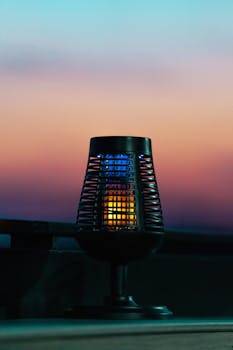
 Photo: Jacoby Clarke · Pexels License · source ↗
Solar light traps for insect monitoring and control
Solar light traps are autonomous nocturnal insect-trapping devices that combine a photovoltaic panel, an LED or CFL light source over a soapy-water or kerosene basin, and a light-sensor circuit that switches the lamp on automatically at dusk. They attract and drown phototactic nocturnal insects in fields and orchards during peak evening activity.
Principle
Many nocturnal lepidopteran and coleopteran pests are strongly phototactic, flying towards artificial light sources during their evening activity peak (typically 7-10 pm). A bright lamp over a trapping basin draws these insects within range, and a baffle or fan directs them into the soapy-water surface where they cannot escape. Solar power eliminates the grid-dependence of conventional mains-powered light traps, making the device deployable in remote fields without electrical infrastructure.
Implementation
ICAR-NCIPM has documented effectiveness across paddy, brinjal, cabbage, chilli, mustard, wheat, onion, guava and green peas. Standard design comprises a 10-20 W solar panel, a battery, an LED or CFL lamp inside a perspex cone, a water basin below and a light-sensor switch. One solar charge supports 8-12 hours of night operation, covering the entire evening insect-activity window. Trap density of one unit per 1-2 acres is typical for monitoring deployments.
Adoption context
Solar light traps are promoted under IPM extension programmes by ICAR, state agriculture departments, and KVKs. They are particularly useful in organic and natural-farming systems where the trap reduces foliar insecticide load and contributes to insect inventory data. Recent extensions cover storage pest management at warehouse and FCI godown scale.
Limitations
The trap catches both pests and beneficial insects (including pollinators and natural enemies) indiscriminately; species-specific monitoring requires later sorting of catches. Battery and lamp service life is finite, and replacement supply chains in remote areas are weak. Heavily clouded or rainy nights compromise solar charging. The technique reduces but does not eliminate the need for targeted insecticide sprays at threshold pest densities.
Related entries
See also Pheromone Traps, Yellow Blue Sticky Traps, Ipm Vegetables and Ipm Chilli Spray Schedule.
References
- Light Trap for use in IPM. ICAR-National Centre for Integrated Pest Management.
- Day and Night Guardian — Solar Solution for Pest Management. ICAR.