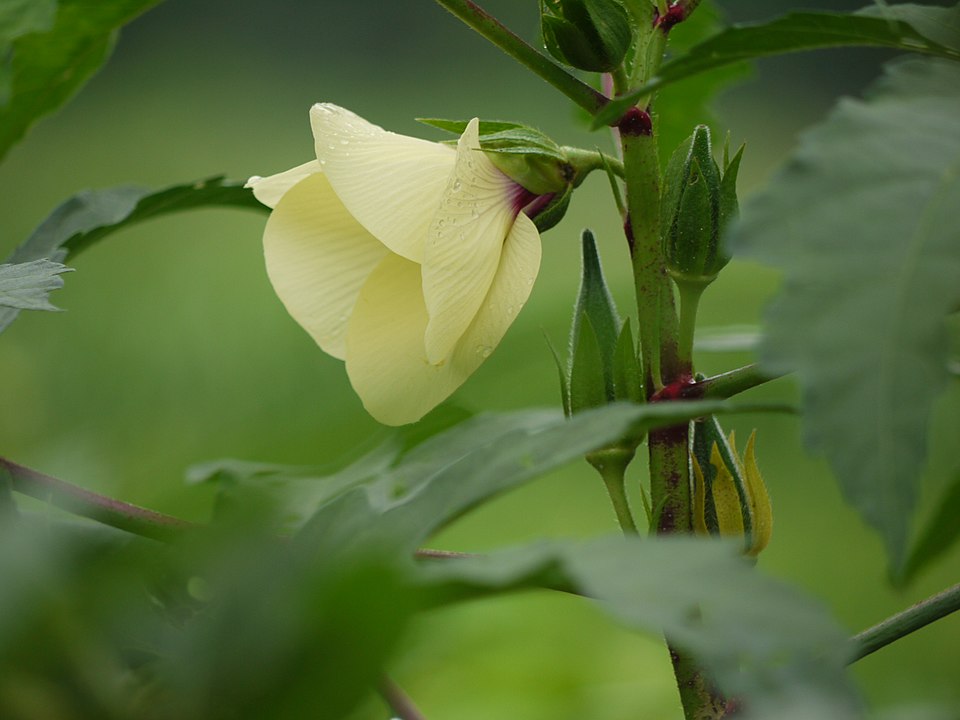
 Photo: Dinesh Valke from Thane, India · CC BY-SA 2.0 · source ↗
_Moench_(6140292159).jpg)
Okra / Bhindi (Abelmoschus esculentus)
Okra (Abelmoschus esculentus), known as bhindi or lady's finger, is a warm-season fruit-vegetable in the family Malvaceae, cultivated across India in both kharif and summer windows. The crop is valued for its tender immature pods, and growers rely on a mix of public-sector tolerant varieties from ICAR-IIVR Varanasi and ICAR-IIHR Bengaluru and private-sector F1 hybrids. The most economically damaging biotic stress is Yellow Vein Mosaic Disease (Okra Yvmv), which has shaped variety choice for decades.
Key characteristics
- Family: Malvaceae
- Soil pH tolerance: 6-8 on loose, well-drained loam
- Seed rate: 8-10 kg/ha for kharif sowing; ~20 kg/ha for summer (Jan-Feb) sowing
- YVMV-tolerant cultivars: Arka Anamika, Arka Abhay, Varsha Uphar
Cultivation
Seed is typically soaked 6-12 hours before sowing to improve and synchronise germination. The crop is direct-sown in rows; nitrogen requirement is high in hybrids, with a balanced 150:150:150 kg N:P2O5:K2O dose recommended for high-yielding cultivars such as Pusa Sawani. Plants begin flowering within 35-45 days, and harvest is repeated every 2-3 days as long as plants remain healthy. Drip irrigation and mulching are standard for commercial summer production.
Pest and disease profile
Yellow Vein Mosaic Virus disease (Okra Yvmv) transmitted by Bemisia tabaci is the dominant constraint; choice of YVMV-tolerant cultivars is the primary management lever. Jassids (Amrasca biguttula biguttula), shoot and fruit borer (Earias spp.) and mites are the major insect pests.
Adoption and use
Public-sector tolerant cultivars dominate small-holder cultivation, while private F1 hybrids such as Okra Variety Kaveri Shourya are widely planted for commercial fresh-market supply.
Related entries
See also: Okra Yvmv, Okra Variety Kaveri Shourya.
References
- Bhendi. Vikaspedia agriculture portal.
- Origin, area, varieties, package of practices for bhendi. TNAU eagri lecture notes.