 Photo: OSU Special Collections & Archives : Commons · No restrictions · source ↗
.jpg)
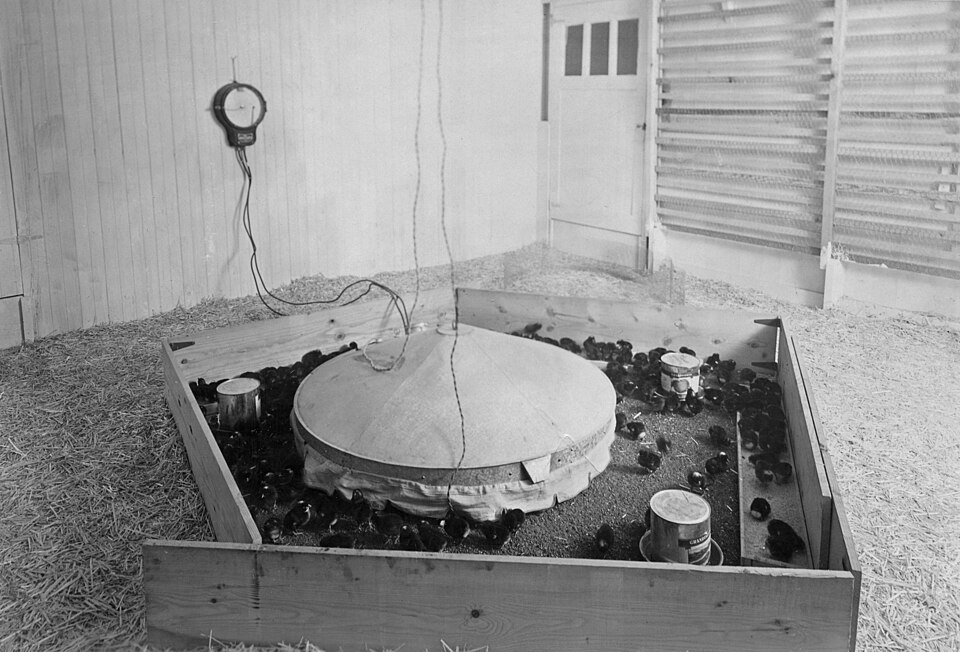
Chick brooding
Brooding is the temperature-controlled rearing of day-old chicks during the first one to three weeks of life, when they cannot regulate their own body temperature. Effective brooding sets up uniform growth, good feathering and strong gut development; brooding errors during this window are the single largest driver of first-week mortality and lifetime flock performance.
Principle
A newly hatched chick has a body-temperature set point of about 40 degC but limited heat production. Until thermoregulation matures around day 14, the chick depends on supplemental heat. Floor temperature, air temperature, humidity and litter temperature must each sit in a narrow band so that chicks remain active, spread evenly across the floor and consume feed and water.
Implementation
Standard targets are 32-35 degC (90-95 F) at chick level during the first week, stepped down by roughly 3 degC per week until shed ambient temperature (around 20-22 degC) is reached at four to six weeks. Relative humidity is held at 60-70%. Heat is supplied by gas brooders, infrared electric brooders or, in small-scale Indian farms, 200 W incandescent bulbs hung over circular brooder guards. Litter is pre-warmed for at least 24 hours before placement so that chick feet meet a warm, dry surface; deep litter material is laid 5-10 cm deep (Deep Litter System).
Chick behaviour is the on-farm indicator that overrides the thermometer. Birds huddled directly under the heat source indicate cold conditions; birds panting at the edge indicate overheating; even distribution with active feeding signals correct temperature. Continuous low-intensity light during the first 72 hours encourages feed and water intake.
Adoption context
Brooding precedes every commercial broiler (Broiler Chicken) and layer (Layer Chicken Bv 380) cycle. Backyard rearers of country chicken (Country Chicken Nattu Kodi) typically rely on the mother hen, accepting higher chick losses in exchange for zero fuel and infrastructure cost.
Limitations
Wide diurnal temperature swings in open-sided sheds (Shed Height Ventilation) make consistent brooding difficult in winter. Inadequate brooding amplifies chick mortality (Poultry Mortality Management) and predisposes survivors to coccidiosis and ascites later in the cycle. Brooder areas must also be included in the inter-batch sanitation cycle (Biosecurity Cleaning Between Batches).
Related entries
See also: Starter Grower Finisher Feed.
References
- Brooding (1-21 days). The Chickipedia, H&N International.
- Brooding and Space Requirements for Poultry. Colorado State University Extension.