 Photo: DOAN THANH BINH · Pexels License · source ↗
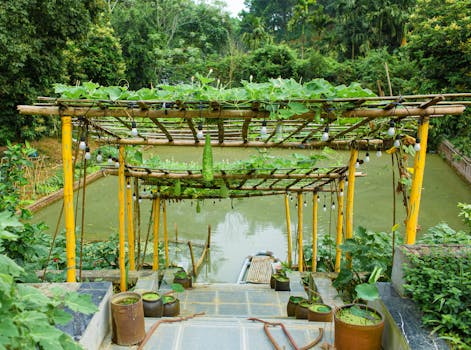
Pandal / pergola construction for climber vegetables
Pandal (pergola) construction is the building of an overhead training grid for climber cucurbits and lablab, supported by stone, concrete or iron pillars with criss-crossed galvanised iron wires. The vines are trained upwards onto the grid and fruit hangs below, separating the harvest from the soil surface.
Principle
Cucurbits and lablab grown on the ground develop fruit in contact with soil moisture and pathogens, leading to fruit rot, irregular shape and difficulty in pollination access. Lifting the vine onto a pandal places the fruit in still, dry air below the canopy, exposes it to consistent shape-forming gravity, and gives bees and other pollinators clear access to flowers. Sun penetration to the lower canopy is more uniform than on a ground-running vine, and the orchard floor remains clear for inter-cultivation.
Implementation
ICAR-IIHR and state horticulture universities recommend pandal cultivation for ridge gourd, bitter gourd, snake gourd, bottle gourd, ash gourd and pointed gourd, alongside lablab. Standard pandal layout uses concrete or stone pillars at approximately 4-5 m spacing supporting a top horizontal wire mesh at roughly 2 m height. Bamboo poles are used in low-cost variants. Permanent concrete or stone pandals are capital-intensive but service 8 to 10 cropping cycles. MIDH provides per-hectare subsidy for permanent vegetable structures.
Adoption context
Pandal cultivation is the dominant commercial system for bitter gourd, ridge gourd and snake gourd in Andhra Pradesh, Telangana, Karnataka, Tamil Nadu and Kerala, and is increasingly used in protected-cultivation polyhouses for high-value cucurbits.
Limitations
Initial capital is significant; permanent pandals cost Rs 2-5 lakh per acre depending on pillar material. Cyclones and high winds can collapse poorly-designed pandals. The fixed structure constrains crop rotation: the pandal site is committed to climber vegetables for its 8-10 year service life. Harvest from overhead positions requires bending the vine or using picking ladders.
Related entries
See also Mulching Vegetables, Tomato Staking Pruning and Drip Fertigation Vegetables.
References
- Division of Vegetable Crops. ICAR-Indian Institute of Horticultural Research.