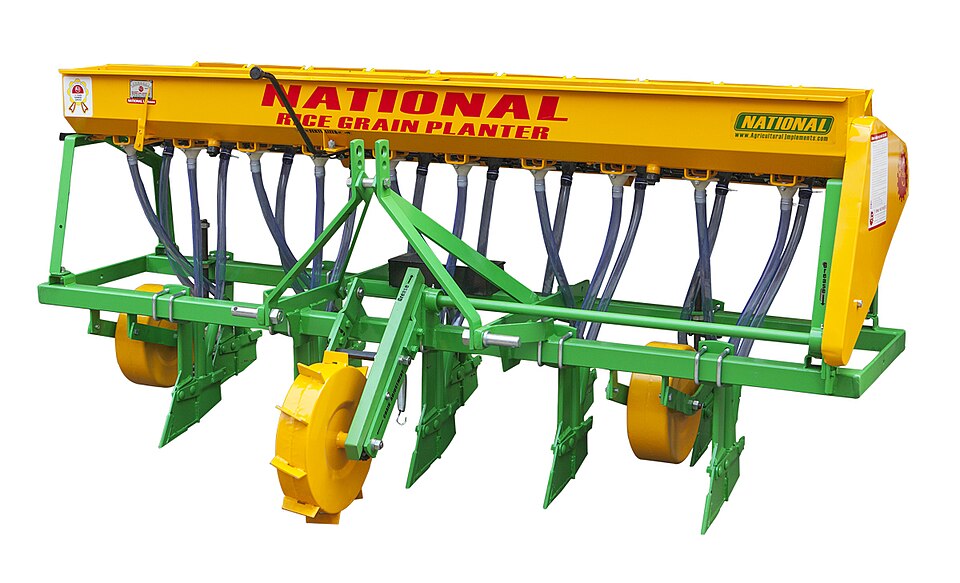
 Photo: FatherofGod · CC BY-SA 4.0 · source ↗
.jpg)
Drum Seeder for Paddy
A paddy drum seeder is a manually pulled walk-behind implement that direct-seeds pre-germinated paddy into a puddled field, bypassing the nursery-and-transplanting cycle. It is the principal mechanised tool for wet direct-seeded rice (DSR-wet) in Indian smallholdings.
Function
Two horizontal cylindrical drums, each with metering holes along their circumference, ride on a common axle between a pair of skids. As the operator pulls the seeder forward across a puddled field, the drums rotate and deposit pre-germinated paddy seed in parallel rows through the holes; the skids leave shallow furrows that hold the seed.
Design and specifications
The principal Indian variants are the ICAR-IIRR (Indian Institute of Rice Research) 8-row drum seeder and the TNAU (Tamil Nadu Agricultural University) fibre-bodied design. Both have eight holes per drum on two parallel drums, sowing eight rows at 20 cm row-to-row spacing. The seed rate is adjustable to 72-75 kg per hectare by varying drum-hole count and ground-wheel revolution.
Operation
The field is puddled to a smooth, level layer with a Roto Puddler or Rotavator using Cage Wheels Tractor, drained to a thin film of water, and the drum-seeder is pulled across in straight passes. Pre-germinated seed (24-hour soaking plus 24-36 hours of sprouting) is loaded into both drums. The technique is an alternative to Paddy Transplanter use and to manual transplanting, eliminating labour-intensive nursery operations.
Subsidy and adoption
The drum seeder is listed under SMAM and various state direct-seeded-rice schemes. AICRP economic comparisons report net returns of approximately Rs 24,250 per hectare against transplanted rice, mainly through saved nursery and labour costs.
Related entries
See also: Paddy Transplanter, Twin Box Seed Drill, Seed Drill, Hand Push Seeder, Cage Wheels Tractor, Paddy Bund Former.
References
- Direct Seeding in Rice Using Drum Seeder. AESA Network.
- IIRR 8-Row Seeder. ICAR-Indian Institute of Rice Research.