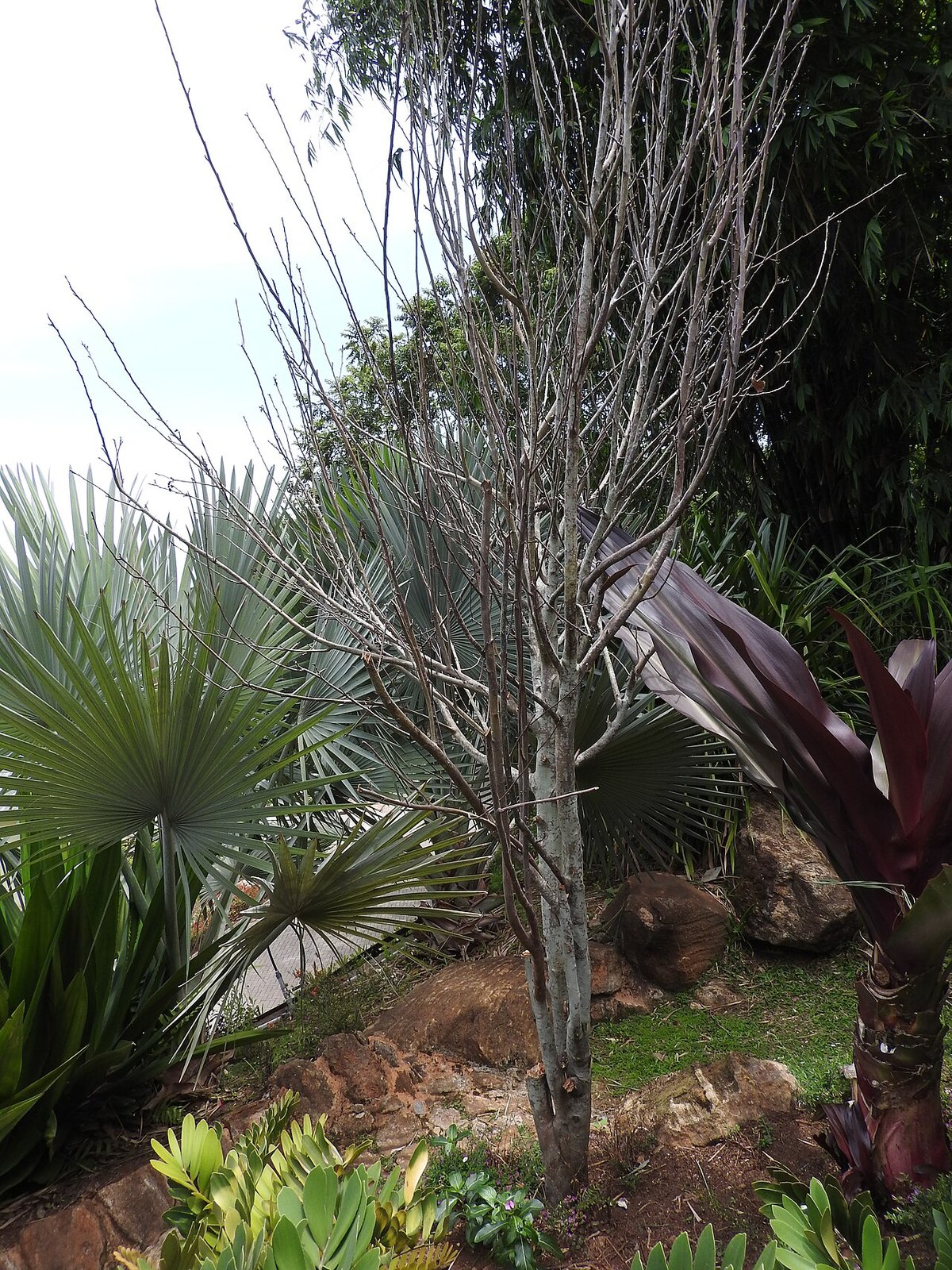
 Photo: Yercaud-elango · CC BY-SA 4.0 · source ↗

Red Delicious apple
Red Delicious is the original colour-strain American Delicious cultivar from which Royal Delicious, Oregon Spur, Red Chief and most modern Indian Delicious-group strains are derived. In India, Red Delicious was introduced to the Kashmir Valley in the early 1900s and to Himachal Pradesh in the 1950s through the Government Apple Orchard at Mashobra. It is grown across the same belts as Royal Delicious and is often interplanted with it.
Key characteristics
- Origin: chance seedling from Peru, Iowa (USA), 1872; introduced to India early 20th century
- Tree: standard non-spur (vigorous, spreading); spur-type strains include Starkrimson, Red Chief
- Fruit shape: elongated truncate-conic with prominent calyx lobes
- Fruit colour: deep solid crimson at maturity
- Flesh: greenish-white turning cream; sweet, mild, low-acid; soft after long storage
- Maturity: late September to early October in Kashmir Valley; mid-September in HP mid-hills
- Chilling requirement: ~1,000-1,200 chilling units
- Yield: 12-15 t/ha on conventional spacing; 40-60 t/ha on HDP after year 5
Cultivation
Red Delicious is propagated by tongue grafting onto seedling crabapple or clonal MM-106 / MM-111 / M-9 / M-26 rootstock (apple rootstocks). It is self-unfruitful — at least one polleniser cultivar (Golden Delicious, Granny Smith, Red Gold, Tydeman's Early or a crab apple) is essential, planted at 1:8 to 1:10 ratio. Standard orchards use 6 x 6 m spacing; modern HDP blocks shift to 1.5 x 3.5 m on M-9 with trellis (HDP). Annual winter pruning to remove crossing branches and water sprouts, combined with summer light-management pruning, is recommended by HRRS Mashobra. Bordeaux paint on cut surfaces prevents canker entry.
Pest and disease profile
Red Delicious is highly susceptible to apple scab (Venturia inaequalis), Marssonina leaf blotch, premature leaf fall and powdery mildew. On the insect side, codling moth, San Jose scale, woolly apple aphid, root borers and mites are major problems. Fruit cracking, bitter pit (calcium deficiency), water-core and cork spot are notable physiological disorders. Calcium chloride sprays (0.5%) from 30 days after petal fall, applied 3-4 times before harvest, are standard for bitter pit prevention.
Adoption and use
Red Delicious is sold both as a fresh table apple and as a long-term cold-storage staple. Because the flesh softens with age in regular cold storage, fruit destined for sale beyond January is shifted to CA storage where 2-3% O₂ + 1-2% CO₂ at 1 °C extends marketable life to 7-9 months. The cultivar's near-uniform deep red colour gives it premium grading at Azadpur mandi. Indian Red Delicious now competes with Iranian and Washington-state imports during winter months; HP growers have begun replanting with Royal Delicious bud sports and Italian colour strains such as Super Chief and Scarlet Spur II to maintain prices.
Related pages
See also: Royal Delicious, Ambri, apple rootstocks, HDP, apple scab, CA storage.
Sources
- Apple: Package of Practices. ICAR-CITH Srinagar.
- Apple Cultivation. HRRS Mashobra, Dr YS Parmar University of Horticulture and Forestry.
- Apple cultivation in India. National Horticulture Board.