 Photo: placeholder pending image-fill pass
Gaddi sheep (Himachal Pradesh, Uttarakhand)
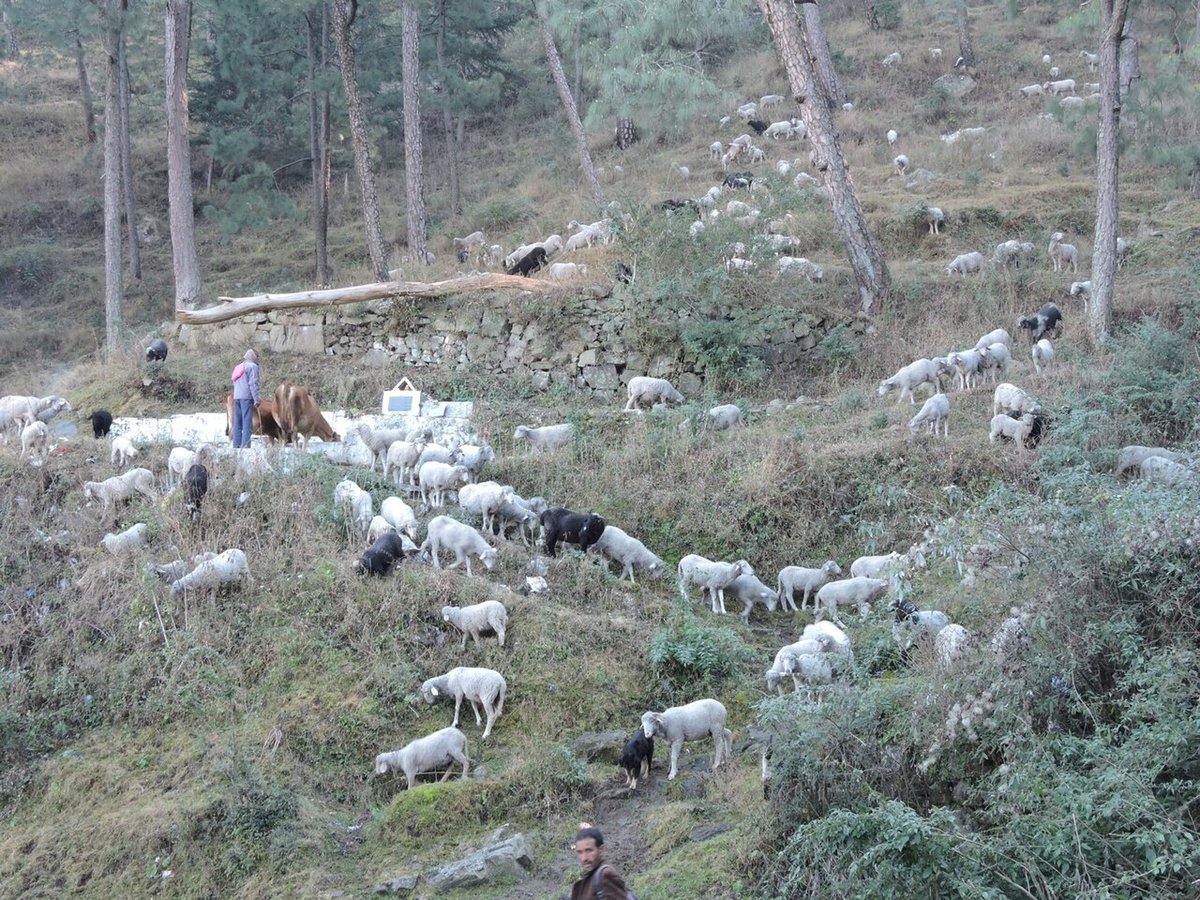
Gaddi is the principal transhumant hill sheep breed of the western Indian Himalayas, registered with the ICAR National Bureau of Animal Genetic Resources (NBAGR). The breed takes its name from the Gaddi shepherd community of the Dhauladhar and Pir Panjal ranges, and is reared as a dual-purpose carpet-wool and meat animal across Himachal Pradesh, Uttarakhand and adjoining parts of Jammu and Kashmir.
Origin and distribution
The breeding tract covers Chamba, Kangra, Kullu, Mandi, Shimla, Kinnaur and Lahaul-Spiti districts of Himachal Pradesh, Doda and Kathua of Jammu region, and Uttarkashi, Tehri, Chamoli and Pithoragarh of Uttarakhand. Flocks are managed under classic vertical transhumance: summer grazing on alpine bugyals and dhars above 3,000 m, monsoon stay in mid-hill valleys, and winter migration to the Shivalik foothills and the Punjab-Haryana plains.
Morphology
Gaddi sheep are medium-sized with a deep, well-built body adapted to long migratory walks. The fleece is generally white, with brown, black and tan-faced animals also common. The body is fully covered with medium-fine wool, with bare face and lower legs. Ears are medium and slightly drooping. Rams are usually horned with stout, spiral horns; many ewes are polled. Adult body weight averages 32-38 kg in rams and 25-30 kg in ewes.
Performance
Annual greasy fleece yield averages 1.0-1.5 kg per animal, distributed over two shearings (autumn and spring). Fibre diameter is around 30-35 microns — coarser than fine-wool synthetic breeds but better than typical desert carpet-wool sheep, making the fleece suited to hosiery, hand-knitted goods and superior carpet yarn. Lambing is single, with an annual lambing interval and age at first lambing of 18-24 months. Gaddi is also the indigenous base for the Kashmir Merino upgrading programme (Kashmir Merino Fine Wool).
Management
Flocks are managed exclusively under transhumant migratory grazing (Migratory Sheep Grazing), often in mixed herds with Gaddi goats. Stationary stall-fed husbandry is rare except on government breeding farms. PPR (Ppr Vaccination Detailed) and small-ruminant vaccination (Small Ruminant Vaccination Schedule) are organised at the foothill wintering grounds by state animal husbandry departments. Predation by leopard and bear, foot-rot during the monsoon stay, and lung-worm infestation are recurring herd-health concerns.
Related pages
See also: Kashmir Merino, Changthangi sheep, Migratory sheep grazing.
Sources
- Gaddi — NBAGR breed descriptor. ICAR-National Bureau of Animal Genetic Resources.
- Transhumant sheep husbandry in the western Himalayas. ICAR-Central Sheep and Wool Research Institute, Avikanagar.