 Photo: placeholder pending image-fill pass
CTC (Cut-Tear-Curl) tea manufacture
CTC — Cut, Tear, Curl — is the dominant manufacturing process for Indian black tea. About 85% of India's roughly 1,300 million kg annual made-tea output is CTC, almost all of it from the [[tea-camellia-sinensis-assamica|assamica]] plains belt of Assam, Dooars, Terai and Tripura. The process was invented in 1930 at the Amgoorie Tea Estate (Assam) by Sir William McKercher and quickly displaced the older "legg-cut" and "rotorvane-only" routes because it gave faster oxidation, higher cup-per-kg yield and granules ideal for the Indian milk-tea market.
Principle
CTC rollers consist of two pairs of helically grooved hard-chrome stainless-steel rollers running at sharply different speeds (about 1:10 ratio). Withered leaf forced through the narrow gap is simultaneously sheared (cut), torn (tear) and rolled into pellets (curl) in a single pass. Cell rupture exceeds 95%, releasing polyphenol oxidase and catechin substrates that drive fast, intense oxidation.
Process steps
- Withering: green leaf is spread 20-25 cm deep on trough loft floors and aerated for 14-18 hours with warm air (28-32 °C) until leaf moisture drops from ~78% to 65-68%. Withering develops aroma precursors and makes the leaf physically pliable.
- Conditioning (Rotorvane): leaf is fed into a barrel-shaped Rotorvane that pre-breaks the leaf into a coarse slurry in 30-60 seconds.
- CTC: the slurry passes through 2-3 banks of CTC rollers in series; the gap between rollers tightens at each stage so granules become progressively finer. Total residence time is under 60 seconds.
- Oxidation: granules are spread 5-8 cm deep on stainless trays or perforated beds at 24-27 °C and 90-95% RH for 60-90 minutes. Liquor colour develops as theaflavins and thearubigins form.
- Firing: oxidised dhool is fired in a fluid-bed drier (FBD) at inlet 120-130 °C, outlet 95-100 °C, for 18-22 minutes. Moisture is brought down to 2.5-3.0%.
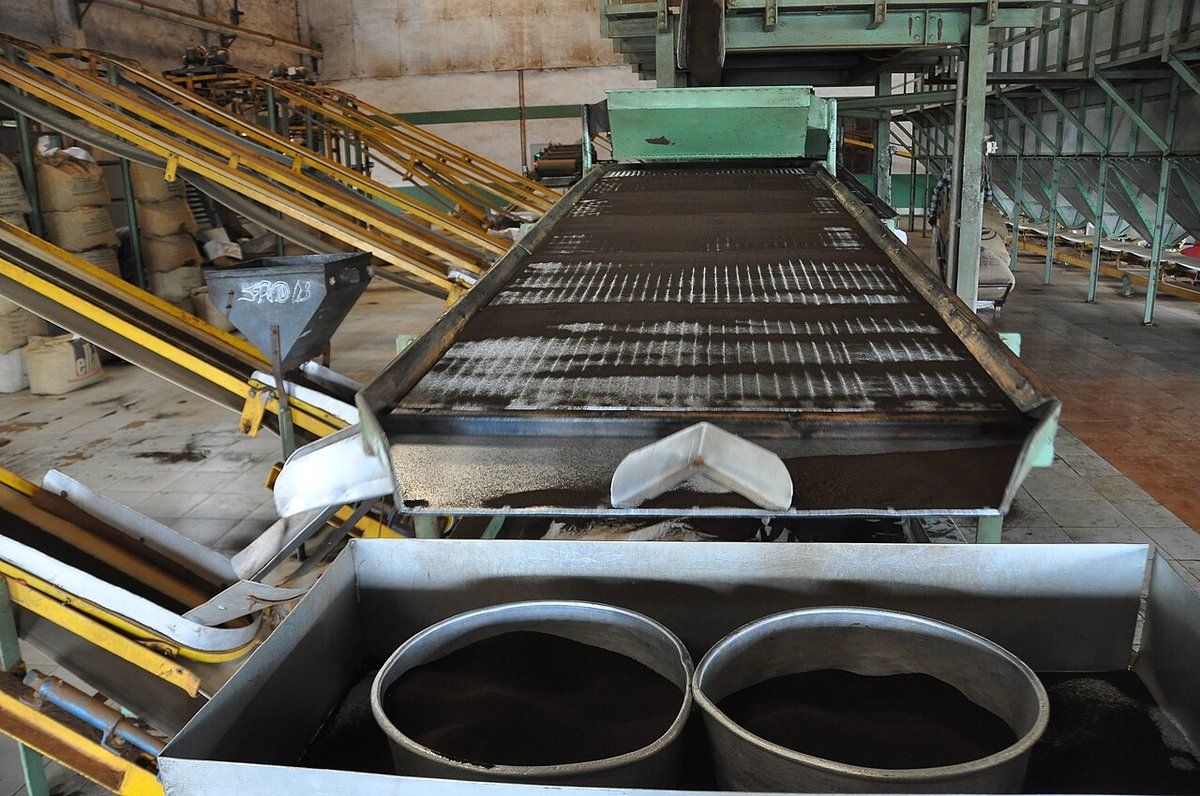
- Sorting and grading: fired tea is sieved through vibrating sorters and dust-extractors into grades — BP (Broken Pekoe), BOP (Broken Orange Pekoe), BOPF (BOP Fannings), PF (Pekoe Fannings), PD (Pekoe Dust), Dust 1, Dust 2.
Output characteristics
CTC granules are hard, dark, granular pellets of 0.5-2 mm. Liquor is strong, coloury, brisk, with high theaflavin content; ideal for milk tea and masala chai. Cup yield is ~400 cups/kg, vs ~250-300 for orthodox whole-leaf.
Adoption
CTC dominates the Indian domestic packet trade (Hindustan Unilever, Tata Consumer, Wagh Bakri) and large export markets in Pakistan, Egypt, the UK and the CIS. Modern CTC factories handle 4-8 t/hour of green leaf, are highly automated, and increasingly integrated with [[tea-tv-1-tocklai-vegetative-clone|TV-clone]] plantations. CTC is sold predominantly through public auction (Tea Auction System India Kolkata).
Related entries
See also: Tea Orthodox Vs Ctc Processing, Tea Camellia Sinensis Assamica, Tea Tv 1 Tocklai Vegetative Clone, Tea Auction System India Kolkata, Tea Assam Orthodox Second Flush Gi.
References
- Tea Research Association Tocklai — CTC Manufacture. https://www.tocklai.org/
- Tea Board India — Manufacturing Statistics. https://www.teaboard.gov.in/