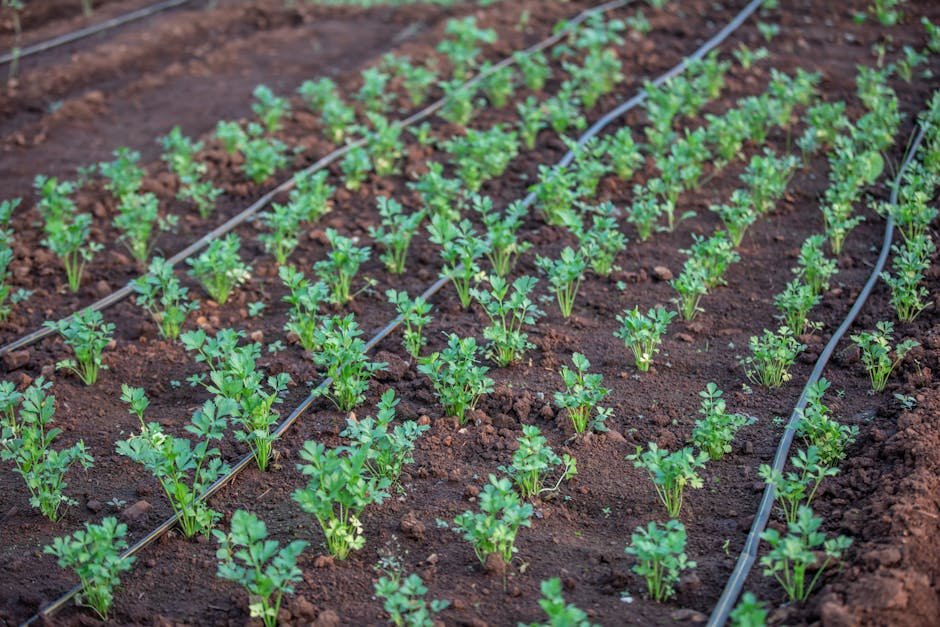
 Photo: Anil Sharma · Pexels License · source ↗
Drip irrigation in rainfed groundnut
Drip irrigation in rainfed groundnut is a hybrid water-management practice that combines monsoon-dependent rainfed sowing with supplementary protective drip irrigation during critical growth stages. The package was developed and demonstrated by ICAR-CRIDA, ICAR-Directorate of Groundnut Research (DGR) and ANGRAU as a response to recurrent mid-season dry spells in the Anantapur-Kurnool-Mahabubnagar rainfed groundnut belt. Multi-year trials have shown 25-60 percent yield gains over fully rainfed cultivation, with the largest gains in deficit-rainfall years.
Principle
Anantapur kharif groundnut faces two characteristic moisture-stress windows: (a) the flowering-to-peg-initiation phase at 35-55 DAS and (b) the pod-filling phase at 75-95 DAS. Mid-season dry spells during these windows account for most of the yield variability in rainfed groundnut. A small volume of supplementary irrigation (5-8 mm per event applied 2-4 times during the season) applied through drip at these critical stages stabilises yield even when total seasonal rainfall is 30-40 percent below normal. The water source is typically a farm pond (Farm Pond) recharged by harvested run-off.
Implementation
ICAR-CRIDA and ANGRAU's recommended package for Anantapur:
- Layout: in-line drip with 16 mm laterals at 60-90 cm spacing on raised beds (Raised Bed Groundnut); emitter spacing 30 cm; emitter discharge 2 lph.
- Filtration: sand filter + screen filter; back-flush every 7-10 days during the irrigation season.
- Operation: 4-6 hour run-time per event delivering 5-8 mm equivalent depth.
- Timing of supplementary irrigation:
- Pre-sowing/seedling stage if SWM onset is delayed - one event of 8-10 mm.
- Flowering (35-40 DAS) - one event if 7+ day dry spell.
- Peg initiation (50-55 DAS) - critical event, applied if rainfall in past 10 days is <30 mm.
- Pod filling (75-85 DAS) - one or two events if dry spell coincides.
- Fertigation: water-soluble NPK 19:19:19 at 2-3 kg/ha per event during flowering and peg initiation, replacing one of the conventional top-dressings.
Where and when it applies
The package suits rainfed groundnut tracts with limited supplemental water - farm pond storage of 100-500 m3 is the typical source. It is most cost-effective on landholdings of 1-3 ha, where the entire farm can be served by a single 0.5-1.0 ha drip block protecting a strategic portion of the crop. PMKSY-Per Drop More Crop (PMKSY Micro Irrigation Subsidy) provides 80-90 percent capital subsidy on drip systems, making the package affordable for smallholders. ANGRAU and KVK Anantapuramu demonstration plots have validated the package across the district since 2008.
Limitations
The practice depends on farm pond water being available at the critical stages; pond construction subsidy under MGNREGS and PMKSY-Other Interventions is essential. Drip system clogging and emitter blockage (Drip Emitter Clogging) are common with calcareous bore-well water and sediment-laden farm pond water - regular flushing and acid washing are needed. Initial capital cost (Rs 80,000-1,20,000/ha after subsidy) is still a barrier for the most marginal farmers. Where farm pond water is exhausted by mid-July, the package collapses to fully rainfed cultivation.
Related entries
See also: Groundnut Crop, Drip Irrigation, Drip Fertigation, PMKSY Micro Irrigation Subsidy, Contingency Cropping Anantapur, Raised Bed Groundnut.
Sources
- Drip irrigation in groundnut. ICAR-Central Research Institute for Dryland Agriculture.
- Micro-irrigation in oilseeds. ICAR-Directorate of Groundnut Research.
- Per Drop More Crop guidelines. PMKSY.