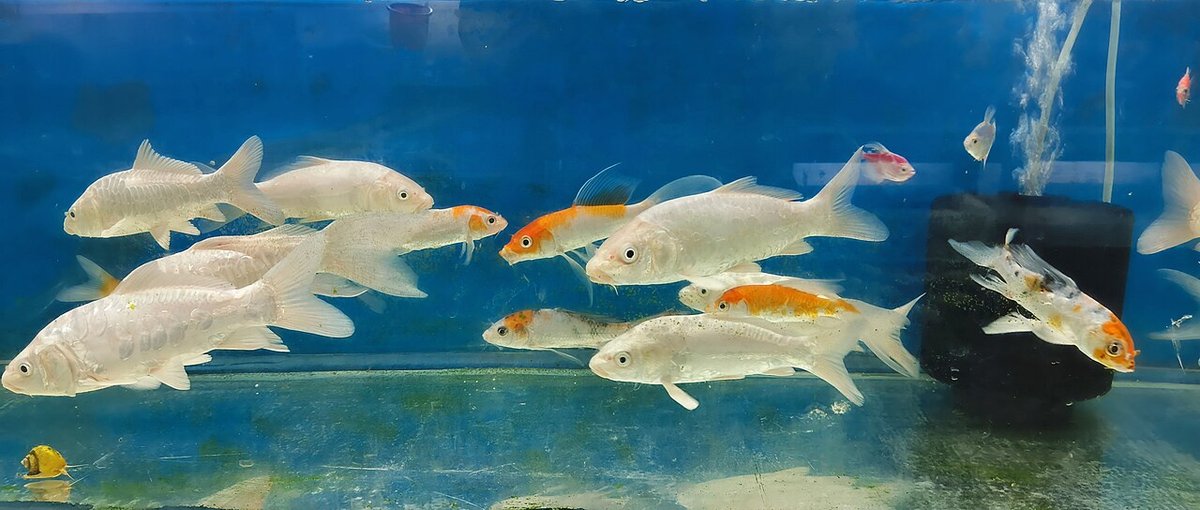
 Photo: Aliva Sahoo · CC BY-SA 4.0 · source ↗
_Aquarium_Display.jpg)
Common carp (Cyprinus carpio)
Common carp (Cyprinus carpio) is an exotic bottom-omnivore carp that has been adopted into Indian composite fish culture as the bottom-feeder partner for mrigal. Two strains are widely used: scale carp (with full scaling) and mirror carp (with reduced scales). Common carp was introduced to India from Sri Lanka in the late 1930s and from Europe in the 1950s, and is now grown in most carp-farming states.
Key characteristics
- Family: Cyprinidae
- Body: deep-bodied, two pairs of barbels around the mouth; scale carp has full scales, mirror carp has irregular large scales
- Feeding niche: bottom omnivore — takes benthic invertebrates, detritus, plankton, supplementary feed and pellet feed; opportunistic feeder
- Growth: 700 g-1 kg in 8-10 months under good management
- Breeding: unlike Indian Major Carps, common carp breeds naturally in confined ponds and tanks
- Cold tolerance: tolerates cool water better than IMCs — important for mid-hill culture in northern India
Cultivation
In six-species composite culture (Composite Fish Culture Six Species) common carp occupies the bottom-omnivore niche alongside mrigal at about 15-20% of stocking. It is also used in mid-hill culture in Himachal Pradesh, Uttarakhand, Kashmir and the north-east where cold-water tolerance is an advantage. Stocking density is 5,000-10,000 fingerlings/ha. Common carp breed prolifically in ponds with grassy margins or aquatic vegetation — uncontrolled recruitment is a known problem, so monosex or all-male tilapia-style culture is sometimes used. Pond preparation follows standard methods (Fish Pond Construction). Supplementary feeding of rice bran and oilcake (1:1) at 2-3% body weight is standard; the species responds well to pellet feed.
Pests and diseases
Common carp is susceptible to argulosis (Carp Disease Argulus Anchor Worm), Aeromonas dropsy (Carp Disease Dropsy Aeromonas), spring viraemia of carp (SVC, exotic), koi herpesvirus (KHV) and gill rot. KHV is a notifiable disease for ornamental koi (C. carpio koi) imports.
Adoption and use
Common carp accounts for a significant share of pond yield in six-species systems and is the principal cultured fish in mid-hill cold-water aquaculture. Indian production is centred in Punjab, Haryana, Himachal Pradesh, Jammu & Kashmir, the north-east and parts of Karnataka. Pond development is supported under PMMSY.
Limitations
Uncontrolled breeding in stocked ponds causes overcrowding and stunting — managed by stocking only one sex, harvesting fry, or using vegetation-free ponds. Common carp can become an invasive pest in natural water bodies, where it disturbs benthic communities by foraging in mud.
Related pages
See also: Composite Fish Culture Six Species, Carp Polyculture Pond, Catla Catla Indian Major Carp, Mrigal Cirrhinus Mrigala Imc, Silver Carp Hypophthalmichthys Molitrix, Grass Carp, Fish Pond Construction.
Sources
- Cyprinus carpio. FAO Cultured Aquatic Species fact sheet.
- Common carp culture in India. ICAR-CIFA Bhubaneswar.
- Carp polyculture in India. Global Seafood Alliance.