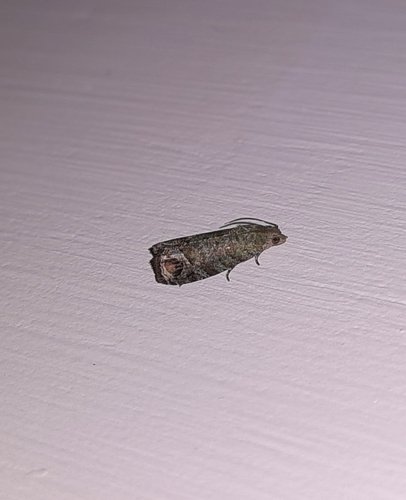
 Photo: Batriti Lamare · CC BY-NC-SA 4.0 · source ↗
Codling moth (Cydia pomonella) on apple
Codling moth, Cydia pomonella (Lepidoptera: Tortricidae), is the world's most damaging pest of apple and pear. In India, codling moth is officially present in Ladakh (Kargil and Leh districts) only — and is a notifiable quarantine pest barred from the Kashmir Valley, Himachal Pradesh and Uttarakhand apple belts under the Plant Quarantine Order, 2003. ICAR-CITH Srinagar, the Department of Plant Protection (Faridabad), and the J&K and HP horticulture departments run an active codling-moth quarantine and area-wide pheromone-trap surveillance programme to prevent spread to the main apple belts.
Identification and symptoms
- Adult: small grey-brown moth, 8-10 mm long, with a characteristic copper-bronze patch at the wingtip.
- Egg: flat, translucent, laid singly on fruit or adjacent leaves.
- Larva: pinkish-cream caterpillar with brown head; up to 18 mm.
- Damage: neonate larvae bore into fruit through the calyx end or sides, leaving a small entry hole plugged with brown frass; inside the fruit, the larva tunnels to the core and feeds on seeds. A second-generation larva exits via a larger hole and pupates in bark crevices, leaf litter or fruit-packing cartons.
The frass-plugged entry hole is the classical diagnostic, distinguishing codling moth from oriental fruit moth and apple maggot.
Hosts and lifecycle
Primary hosts: apple, pear, quince, walnut, apricot. The pest passes the winter as a diapausing prepupa in a hibernaculum (silk cocoon) in bark crevices, soil litter or stored fruit cartons. In Ladakh's Kargil/Leh climate, 1-2 generations per year are typical; in Kashmir/HP climate, models project 2-3 generations if introduced. Adult emergence and oviposition are tied to degree-day accumulation above 10 °C (~100 DD after biofix).
Damage and economic impact
In endemic regions internationally, unmanaged codling moth causes 50-90% fruit damage and renders fruit unmarketable. In Ladakh, growers report 20-40% fruit infestation in untreated orchards. The quarantine status against codling moth is the principal reason Indian apple from Kashmir/HP can move freely interstate and continues to fetch premium prices; introduction would be catastrophic for the ₹15,000+ crore Kashmir apple economy.
Management
ICAR-CITH and the Department of Plant Protection recommend:
- Quarantine vigilance: prohibit the movement of apple/pear/quince fruit, planting material and used packing cartons from Ladakh into Kashmir/HP/Uttarakhand. Pheromone-trap grids (Codlemone, E,E-8,10-dodecadien-1-ol) at 1 trap/ha at orchard borders and apple markets are checked weekly.
- Within-Ladakh management: mass trapping at 25 traps/ha + mating disruption with Isomate-C dispensers + sanitation of fallen fruit and bark scraping in winter.
- Chemical: chlorantraniliprole 18.5% SC (0.4 ml/L), spinosad 45% SC (0.3 ml/L) or emamectin benzoate (0.4 g/L) timed to first-generation egg hatch. Avoid pyrethroids that flare San Jose scale and mites.
- Biological: Trichogramma embryophagum egg parasitoid releases and codling-moth granulovirus (CpGV) commercial formulations are used internationally.
Related pages
See also: Royal Delicious, Red Delicious, HDP, apple scab, fire blight.
Sources
- Codling moth on apple. ICAR-CITH Srinagar.
- Codling moth management. HRRS Mashobra, Dr YS Parmar University.
- Codling moth (Cydia pomonella). CABI Compendium.