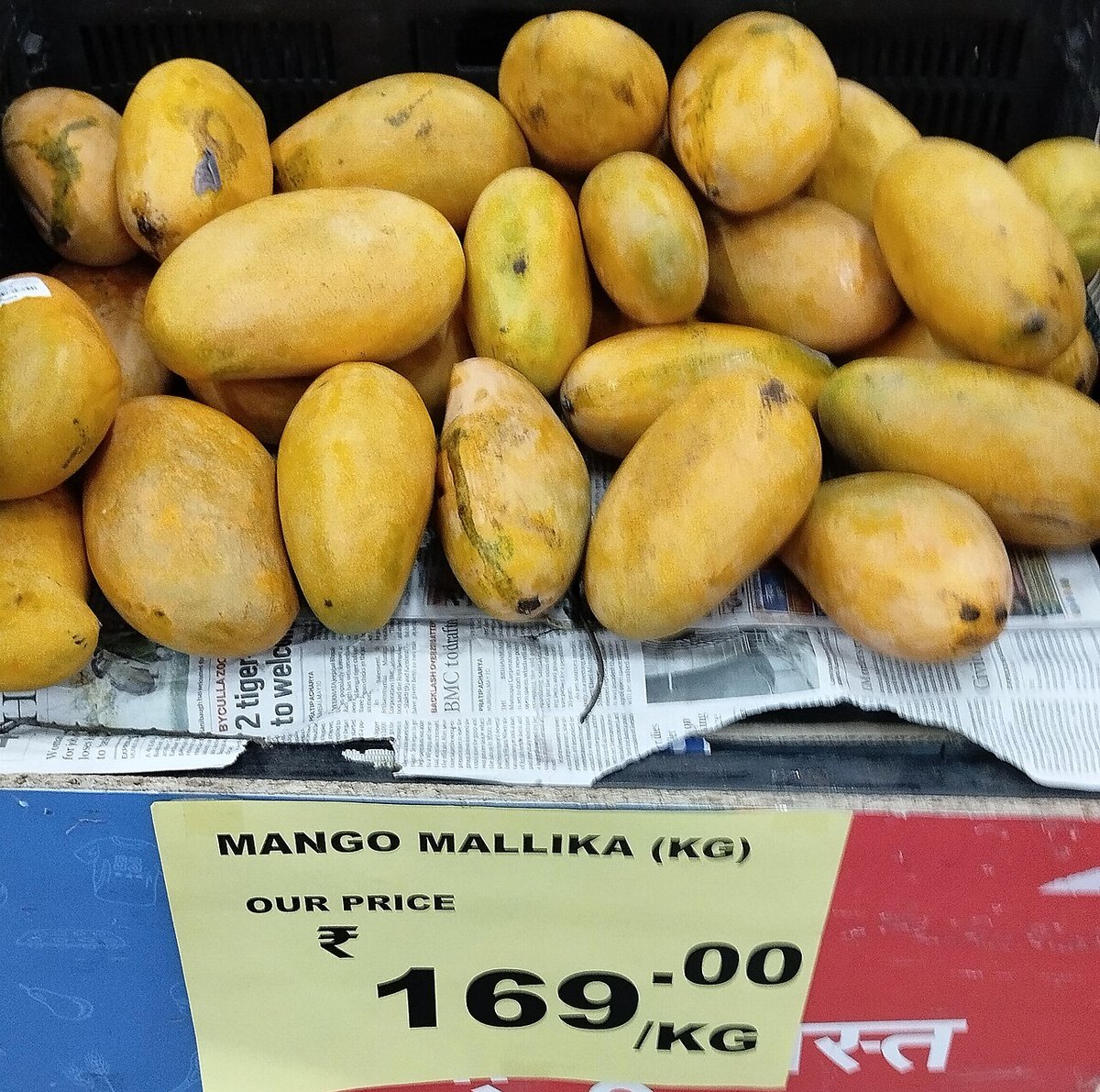
 Photo: Dr. Raju Kasambe · CC BY-SA 4.0 · source ↗
.jpg)
Mallika mango
Mallika is a regular-bearing hybrid mango developed at the Indian Agricultural Research Institute (IARI), New Delhi, in 1971 by Dr R. N. Singh, from the cross Neelum x Dasheri. It is among the most successfully adopted Indian mango hybrids and is widely planted across south India, including the Chittoor and YSR Kadapa mango clusters of Rayalaseema, because it combines the regular bearing habit of its female parent Neelum with the quality and aroma of Dasheri.
Key characteristics
- Pedigree: Neelum (♀) x Dasheri (♂)
- Developed by: ICAR-IARI, New Delhi (1971)
- Bearing habit: regular bearing (not strongly alternate)
- Fruit weight: 300-500 g
- Shape: oblong, slightly necked
- Skin: yellow at maturity, smooth
- Pulp: deep yellow-orange, fibreless, firm, very sweet, with strong Dasheri-type aroma
- TSS: 20-23 deg Brix
- Season: mid- to late-season (June-July in north India; May-June in south India)
- Keeping quality: very good — well-suited to long-distance transport
Cultivation
Mallika is propagated by softwood grafting on local seedling rootstock. Conventional plantings use 8 x 8 m spacing; ICAR-IIHR Bangalore has demonstrated high-density planting (Mango Orchard Establishment Hdp) at 5 x 5 m and 3 x 2 m with regular pruning (Mango Canopy Training Pruning). Flowering management with paclobutrazol and KNO3 (Mango Flowering Management) is used in commercial Karnataka and Andhra Pradesh orchards. The hybrid performs well across the agro-climatic range from the Konkan to the Deccan plateau.
Pest and disease profile
Mallika is moderately susceptible to mango hopper (Mango Hopper Amritodus Idioscopus) and mealybug, and to anthracnose (Mango Anthracnose Colletotrichum) and powdery mildew (Mango Powdery Mildew) during humid flowering periods. Fruit fly (Fruit Fly Orchard Pest) damage at maturity is comparable to other mid-late cultivars.
Adoption and use
Mallika is planted commercially across Karnataka, Andhra Pradesh, Telangana, Tamil Nadu, Maharashtra, Gujarat and parts of north India. In Rayalaseema it is often interplanted with Banganapalli (Mango Banganapalli Beneshan) and Totapuri (Mango Totapuri) to extend the harvest window into June-July when early-season cultivars are over. The fruit's strong aroma and good shelf life make it a favourite of pulp processors and export marketers; it is consumed primarily as fresh table fruit.
Related pages
See also: Mango Neelum, Mango Banganapalli Beneshan, Mango Alphonso, Mango Dasheri, Mango Hopper Amritodus Idioscopus, Mango Anthracnose Colletotrichum.
Sources
- Improved mango varieties. ICAR-IIHR Bangalore.
- Mango cultivars. ICAR-CISH Lucknow.