 Photo: Zaryab Haider · Pexels License · source ↗
Allahabad Safeda guava
Allahabad Safeda is a classic Indian white-fleshed guava cultivar originating in the Allahabad (Prayagraj) region of Uttar Pradesh. It is one of the most widely planted commercial guava varieties in north and central India and is the parental basis of several ICAR-CISH breeding lines.
Key characteristics
- Origin: Allahabad (Prayagraj), Uttar Pradesh
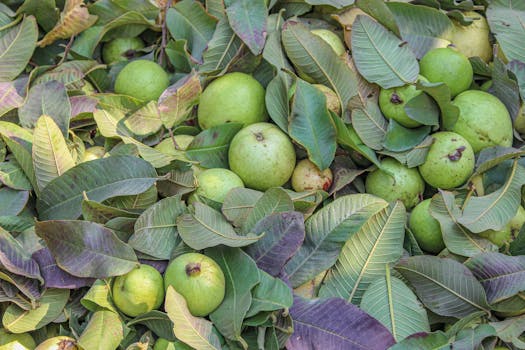
- Fruit: smooth, round, medium-large; greenish-white skin turning pale yellow at ripening
- Flesh: white, firm, sweet with mild aroma; high keeping quality
- Bearing seasons: rainy crop (July-September) and winter crop (November-February); the winter crop is considered superior in flavour and shelf life
- ICAR-CISH progeny: CISH-GS-35, a half-sib selection with soft seeds and high TSS (around 14 deg Brix)
Cultivation
Allahabad Safeda is propagated through air-layering, patch-budding or wedge-grafting on guava seedling rootstock. Conventional spacing is 6 x 6 m; high-density plantings at 3 x 6 m or 3 x 3 m are also used. Annual pruning in May and October (Guava Pruning Cycle) is used to time the heavy winter harvest and to maintain manageable tree height.
Pest and disease profile
The variety is susceptible to Fusarium-induced guava wilt in heavy soils and to anthracnose during humid spells. Mealybug (Mealybug Orchard Pest) and fruit fly are recurring pest problems and are managed through orchard sanitation, biocontrol and methyl-eugenol traps.
Adoption and use
Allahabad Safeda accounts for a significant share of north Indian guava plantings and is sold mainly as fresh fruit; the firm flesh and white pulp also suit jelly, juice and slice processing. It serves as the benchmark against which newer pink-fleshed cultivars such as Taiwan Pink (Guava Taiwan Pink) and CISH selections are compared.
Related entries
See also: Guava Taiwan Pink, Guava Pruning Cycle, Mealybug Orchard Pest.
References
- Guava varieties. ICAR-CISH Lucknow.
- Guava L-49 and varieties. National Horticulture Board.