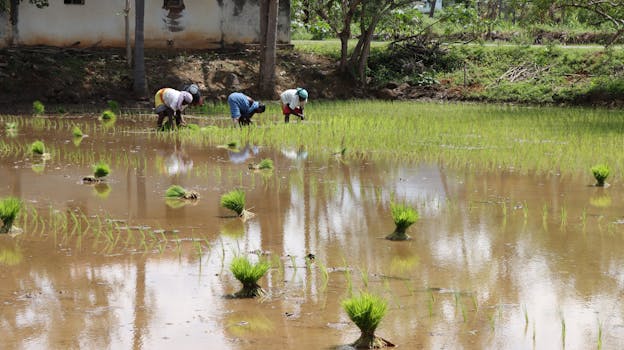
 Photo: Dr.Vivasayam YouTube Channel · Pexels License · source ↗
Jeevamrutham (cow-based fermented liquid input)
Jeevamrutham is a fermented cow-product-based microbial inoculant central to Subhash Palekar Natural Farming (SPNF) and the Andhra Pradesh Community Managed Natural Farming (APCNF) protocol. The preparation is the standard on-farm biological input used as a soil drench, irrigation amendment or foliar spray in orchard and field-crop systems practising natural farming.
Composition and preparation
The standard recipe ferments the following in 200 litres of water:
- Desi cow dung: 5-10 kg
- Cow urine: 5-10 litres
- Jaggery: 1-2 kg
- Pulse flour (besan): 1-2 kg
- A handful of bund soil
Fermentation is carried out in shade under cover for 48-72 hours, with stirring twice daily. The cured liquid has a characteristic sweet-fermented odour. The variant prepared as a solid is Ghana Jeevamrutham.
Mode of action
The product is a high-density mixed microbial culture, not a quantified NPK fertiliser. The cow-dung and bund-soil inoculum, supported by jaggery and pulse flour as substrates, multiplies into a dense population of nitrogen-fixing bacteria, phosphate solubilisers, lactic acid bacteria, yeasts and saprophytic fungi. Applied to moist soil, this culture is intended to establish in the rhizosphere and accelerate mineralisation of soil organic matter and crop residue. In orchards, repeated drenches at low rates aim to maintain microbial activity around perennial root systems.
Target use and dose
- Bulk soil drench: roughly 200 litres of fermented liquid per acre, applied through irrigation water.
- Microbial starter on compost or mulch: as little as a spoonful to a quarter litre placed on top of organic matter at the planting pit; the small starter dose is intended to seed microbial activity in well-mulched orchard soil rather than provide bulk nutrition.
In tree-crop systems, jeevamrutham is often combined with thick mulch and periodic Ghana Jeevamrutham application to maintain soil cover and microbial habitat.
Adoption context
The preparation is the centrepiece of the APCNF/RySS programme in Andhra Pradesh, where it has been scaled to large farmer cohorts. Independent agronomic evidence on its standalone effect is mixed and depends strongly on baseline soil organic matter and mulch availability; it is best understood as one component of a larger natural-farming system.
Related entries
See also: Jeevamrutham Drava, Ghana Jeevamrutham, Panchagavya, Vermiwash, Microbial Biofertilizers, Fym Farmyard Manure.
References
- Organic Fertilizer (Jeevamrit) and Beejamrit. LI-BIRD.
- Agriculture Department - APCNF Practices. West Godavari District, Government of Andhra Pradesh.