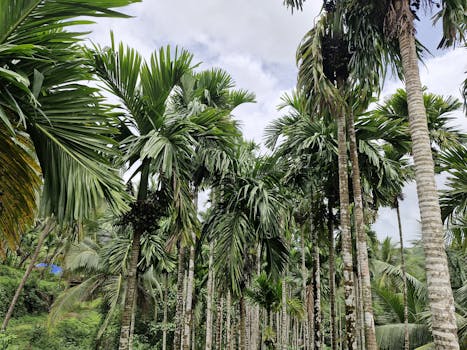
 Photo: Ahila Joshi · Pexels License · source ↗
Mohit Nagar arecanut
Mohitnagar is a high-yielding arecanut variety released by ICAR-CPCRI in 1991. It was developed for the humid sub-tropical and coastal arecanut belts and is among the standard varieties promoted by the Coconut Development Board and the Directorate of Arecanut and Spices Development.
Key characteristics
- Release: ICAR-CPCRI, 1991
- Morphology: medium-thick stem, partially drooping crown
- Bunch arrangement: well-placed bunches with loosely arranged nuts
- Average chali (dry kernel) yield: approximately 3.67 kg/palm/year
- Recommended regions: West Bengal, coastal Karnataka and coastal Kerala
Cultivation
Mohitnagar is propagated from seed nuts selected from elite mother palms, following the package of practices for arecanut documented by ICAR-CPCRI (see Areca Nut Cultivation). It is grown at the standard 2.7 x 2.7 m spacing with pits of 60 x 60 x 60 cm, and is being trialled in newer arecanut belts such as Telangana, often under partial shade in coconut intercropping systems.
Adoption and use
Because of consistent yield potential under good management and broad regional adaptability, Mohitnagar is one of the more widely planted notified arecanut varieties in eastern India and the Karnataka-Kerala coastal tract. The harvested nuts are processed into chali (dry kernel) for the betel-nut trade.
Related entries
See also: Areca Nut Cultivation.
References
- Arecanut Varieties. ICAR-CPCRI.
- Varieties/Hybrids Developed. ICAR-CPCRI Crop Improvement publication.