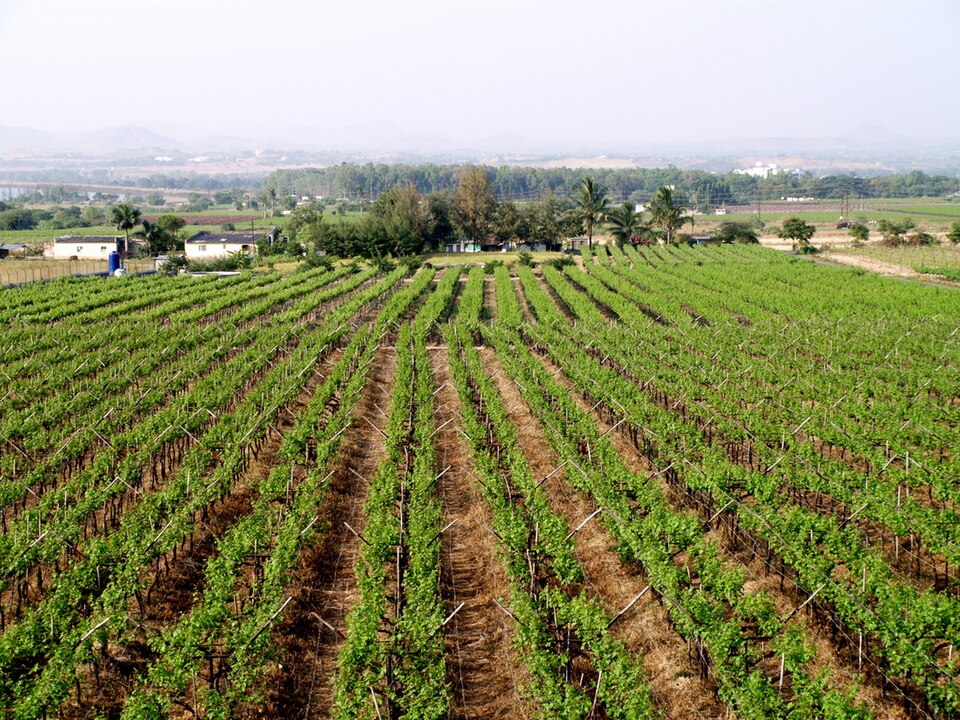
 Photo: Pablo Ares Gastesi · CC BY-SA 2.0 · source ↗

Grape back-pruning and double-cycle
Back-pruning and forward-pruning together form the double-cycle grape management system used across most of the western and southern Indian commercial grape belts (Maharashtra, North Karnataka and Andhra Pradesh). The system splits the year into a vegetative phase that builds new fruiting canes and a reproductive phase that produces the marketable crop.
Principle
Indian table grapes such as Thompson Seedless and its mutants do not undergo strong winter dormancy as they would in temperate climates. Growers therefore impose dormancy artificially by two annual prunings: an April "back pruning" (also called growth or foundation pruning) that cuts canes back to one or two buds, and a September-October "forward pruning" (fruit pruning) that cuts the now-mature canes to leave fruiting buds.
Implementation
The cycle proceeds approximately as follows in Maharashtra:
- April (back pruning): canes cut to 1-2 buds; new shoots grow and mature over 4-5 months under high temperatures and irrigation.
- August-September (rest): water is withheld for around one month to harden canes after the summer flush.
- September-October (forward pruning): matured canes are cut back to leave fruiting buds; flowering occurs in 25-30 days.
- December-March: berry development, ripening and harvest.
Cane selection, bud retention, growth-regulator schedules (gibberellins, CCC) and irrigation are all tied to this calendar; ICAR-NRC Grapes Pune publishes detailed technical bulletins.
Adoption context
The double-cycle system is the basis of Maharashtra's table-grape export industry and is being extended to growers in Karnataka and Andhra Pradesh. It is often combined with protected-cultivation poly-covers (Grapes Bagging Trellis Protected) to reduce rain damage on the maturing fruit crop.
Limitations
The system is labour-intensive, demands precise timing, and is sensitive to unseasonal rain at either pruning. Excess shoot vigour or bud necrosis between pruning cycles can sharply reduce yields, which is why ICAR-NRCG protocols emphasise canopy load management and balanced fertigation.
Related entries
See also: Grapes Bagging Trellis Protected.
References
- Fruit Pruning in Grapes. ICAR-NRC Grapes Technical Bulletin 14.
- Training and Pruning in Grapes. ICAR-NRC Grapes Technical Bulletin 9.