 Photo: Red58bill · CC BY 3.0 · source ↗

Vermicompost
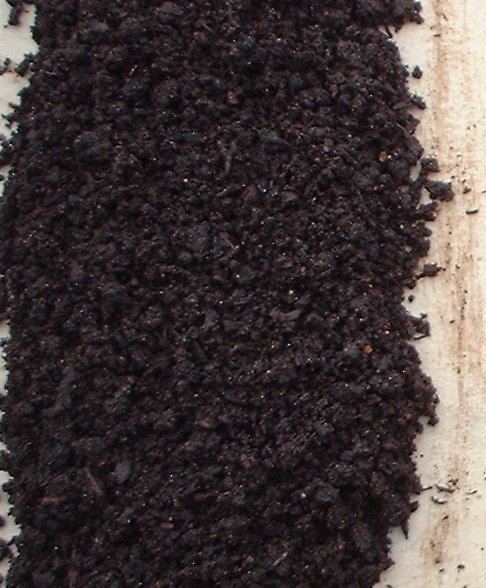
Vermicompost is the dark brown-black granular product of earthworm-mediated decomposition of organic residues. Compared with conventional compost, it is finer in texture, richer in plant-growth-promoting microbes and more uniformly mineralised, and is the most widely produced commercial organic fertiliser in India after farmyard manure.
Composition
- Macronutrient content: typically 1.5-2% N, 1-2% P2O5 and 1-1.5% K2O on a dry-weight basis, varying with feedstock
- Secondary constituents: humic substances, enzymes, plant-growth hormones, beneficial microbes
- Appearance: dark brown to black, fine granular, near-odourless
- Earthworm species: Eisenia fetida (red wiggler, epigeic) is the preferred Indian production species
Production
Vermicomposting is carried out in shaded cement or HDPE tanks, or on the ground in protected beds, at temperatures of 15-25 deg C. Feedstock (cow dung, crop residue, kitchen waste) is pre-decomposed for 15-20 days to vent ammonia, then loaded into beds with Eisenia fetida and maintained at 40-60% moisture with regular sprinkler watering. Mature vermicompost is typically ready in 8-10 weeks. Production specifications are notified under the FCO via the National Centre of Organic Farming (NCOF).
Mode of action
The earthworm gut homogenises and breaks down the substrate, while its associated microflora completes humification. The resulting product supplies a balanced spectrum of macro- and micronutrients in slow-release form, raises soil cation-exchange capacity, improves soil aggregate stability, and inoculates the soil with beneficial microbes including PGPR and antagonists of soil pathogens. Effects on crop yield are largest on degraded or low-organic-carbon soils.
Target use and dose
- Field crops: 1-2 t per acre as basal organic amendment.
- Vegetables and orchards: 2-5 t per acre, often blended with FYM.
- Pot mixtures: 10-25% by volume of the growing medium.
- Seedling and pre-plant treatments: 10-25 g per planting hole.
Adoption and regulation
Widely produced commercially in India and used in both certified-organic and conventional farming systems. Quality varies between producers; certified products under FCO standards specify maximum heavy-metal limits and minimum nutrient and microbial counts.
Related entries
See also: Vermiwash, Fym Farmyard Manure, Panchagavya, Jeevamrutham Drava, Humic Acid, Waste Decomposer Ncof.
References
- Vermicompost. Wikipedia.
- Vermicomposting Using Eisenia foetida. Springer Nature.