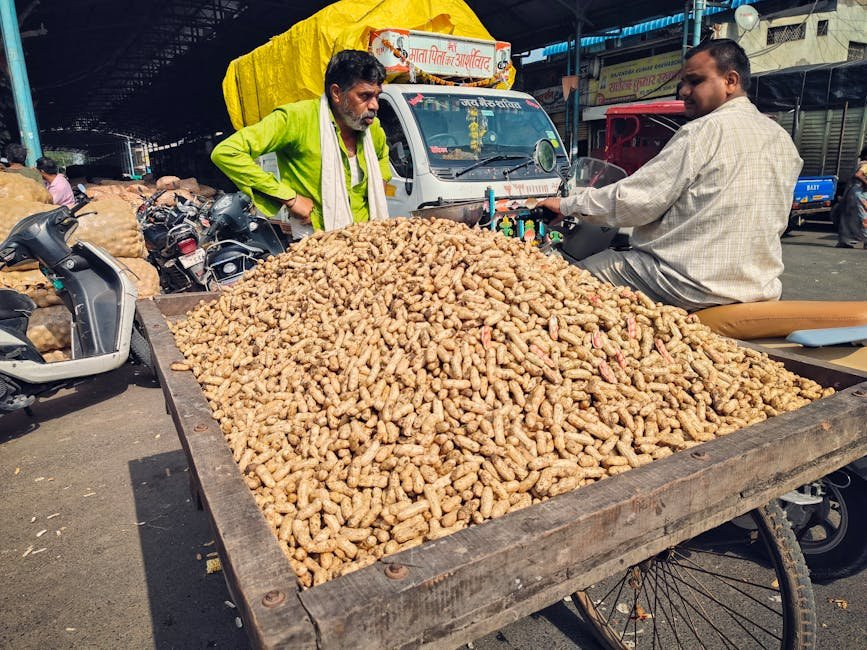
 Photo: Vivek Yadav · Pexels License · source ↗
NAFED groundnut MSP procurement in Andhra Pradesh
The National Agricultural Cooperative Marketing Federation of India (NAFED) is the central nodal agency for procurement of groundnut under the Price Support Scheme (PSS), the government's mechanism for buying pulses and oilseeds when mandi prices fall below the minimum support price (MSP). In Andhra Pradesh — particularly the Anantapur-Kurnool-YSR Kadapa rainfed belt — NAFED PSS procurement is how the announced groundnut MSP is actually realised at the farmer level.
Scope and launch
The Price Support Scheme is operated under the Department of Agriculture, Cooperation and Farmers Welfare (DAC&FW). When mandi prices fall below MSP for a notified crop and state, the state government requests central permission to open PSS procurement; on approval, NAFED — alongside CCI for cotton and FCI for paddy and wheat — is designated as the central agency to procure at MSP from registered farmers and store/dispose the stock on government account.
Eligibility and exclusions
The scheme is open to landholding farmers cultivating notified groundnut varieties in the announced district, registered on the state-level PSS portal before sowing or by a notified cut-off. Eligibility conditions:
- Holding of cultivable land recorded in pattadar passbook or land-revenue records
- Aadhaar-seeded bank account for direct credit
- Online registration on the state agriculture marketing portal (e-Markets AP for Andhra Pradesh) with pattadar, Aadhaar and bank details
- Self-declared sown area, verified by Mandal Revenue or Agriculture staff
- Crop conforms to Fair Average Quality (FAQ) specifications notified by DAC&FW for the year (moisture, foreign matter, oil content, kernel-to-shell ratio)
Benefit structure and price
The benefit is the difference between the notified MSP and the average prevailing market price; PSS pays MSP into the farmer's bank account against verified delivery to a NAFED-empanelled collection centre. The kharif groundnut MSP is notified by the Commission for Agricultural Costs and Prices (CACP) every year (Rs 6,377/q for 2023-24 and revised periodically). The full MSP — not the difference — is paid against delivery; NAFED later disposes of stock to oil-millers, public stockists or as buffer.
Implementation
NAFED appoints state-level partners — APMARKFED in AP, MARKFED in Telangana, KAPPEC in Karnataka — to operate physical procurement centres at notified APMCs and rural collection points. Farmers bring graded, FAQ-grade pods, receive a token, and after weighment and quality test (moisture meter, sample shelling) are credited directly to bank account within 7-15 working days. A cap on quantity per farmer (typically 25-40 quintals) limits over-registration. The Anantapur and Kadiri APMC yards are the major collection points for the south-Rayalaseema belt.
How farmers register
Farmers register on the e-Markets AP portal before the procurement window opens — typically October-December for kharif groundnut — and receive a slot date at the nearest collection centre. They must bring the produce in FAQ condition (8% moisture max; <2% foreign matter; >70% sound kernels). A pattadar passbook copy, Aadhaar and bank passbook are mandatory at the centre.
Limitations
PSS procurement runs only after state requests and central approval, so it usually lags the post-harvest price crash by 4-8 weeks. Storage capacity, gunny supply and lab-test bottlenecks slow centre operations, leading to long queues during peak intake. Some traders route private produce through proxy farmers, eroding the scheme's targeting. Final disposal at sub-MSP prices imposes losses that have led to political tension over scheme continuation.
Related pages
See also: MSP — Minimum Support Price, Groundnut crop, Kadiri-6 groundnut, APMC mandi system, Anantapur district profile.
Sources
- NAFED procurement operations under PSS. National Agricultural Cooperative Marketing Federation of India.
- MSP for kharif crops. Commission for Agricultural Costs and Prices.
- Price Support Scheme operational guidelines. Department of Agriculture, Cooperation and Farmers Welfare.