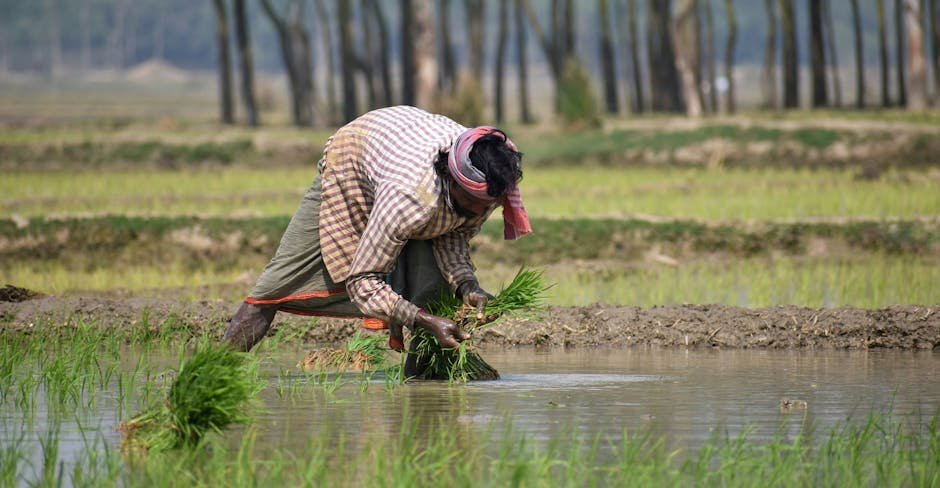
 Photo: placeholder pending image-fill pass
Linseed / flax (Linum usitatissimum) cultivation in India
Linseed (Linum usitatissimum L., family Linaceae) is a rabi oilseed and fibre crop grown for its omega-3 rich oil (45-55 percent alpha-linolenic acid) and, in a few states, for stem fibre. India is the world's second-largest linseed area holder with about 2.4 lakh hectares and produces 1.4-1.6 lakh tonnes annually. Madhya Pradesh, Chhattisgarh, Uttar Pradesh, Bihar, Maharashtra, Jharkhand and Odisha together account for over 90 percent of national area. The crop is grown mostly under rainfed conditions or as a relay (utera/paira) over rice.
Importance and uses
Indian linseed oil is largely used in two streams: (a) industrial drying-oil for paints, varnishes, linoleum, printing inks, soaps and oil cloths, where high alpha-linolenic acid is the basis of the drying property; and (b) a smaller but rapidly growing health-food market for flax seed (alsi) as a source of dietary omega-3 fatty acids, lignans and soluble fibre. Cake (linseed meal) is a high-protein (30-32 percent) cattle and aquaculture feed. The stem yields flax fibre used in linen — although industrial-scale fibre extraction in India is limited.
Agro-climatic zones
Linseed is grown in three broad ecologies: - Utera/paira (relay) system — Chhattisgarh, eastern Madhya Pradesh, southern Bihar, Odisha. Seed broadcast 7-15 days before rice harvest into standing crop; uses residual soil moisture; very low input. - Rainfed sole crop — Bundelkhand UP, north MP, western Maharashtra; sown after October rains on conserved moisture. - Irrigated sole crop — north and west MP, parts of UP and Bihar; one or two protective irrigations at flowering and capsule-filling.
The crop prefers well-drained loam to clay loam soils, pH 6.0-7.5, with 450-750 mm rainfall over the season. Temperature optimum is 10-20 deg C during vegetative growth and 20-25 deg C at maturity.
Agronomy
Sowing is between mid-October and mid-November for sole crops. Seed rate 25-30 kg/ha for sole crop, 35-40 kg/ha for utera; row spacing 25-30 cm. Recommended fertiliser is 60:40:30 NPK kg/ha with 20 kg sulphur per hectare; the crop responds strongly to sulphur because of high lipid synthesis demand. Seed treatment with carbendazim 2 g/kg + thiram 3 g/kg controls wilt and damping-off. Linseed yield averages 6-8 q/ha rainfed, 12-15 q/ha irrigated, with oil content of 36-44 percent. Harvest is in February-March when capsules turn brown and rattle on shaking.
Pests and diseases
The most damaging pest is the linseed bud fly (Dasineura lini) — see Linseed Budfly Resistant Variety for tolerant varieties — followed by jassid and aphid. The main diseases are rust (Melampsora lini), wilt (Fusarium oxysporum f.sp. lini), Alternaria blight and powdery mildew. Resistant varieties (PKDL-41, Padmini, Sheela), seed treatment, balanced fertilisation and need-based foliar protection are the standard management package.
Marketing and policy
Linseed is one of the 23 MSP crops; the 2024-25 RMS MSP was ₹7,797/qtl. Procurement is limited; most farmer-marketed surplus moves through private mandis to oil expellers in Bharatpur, Indore, Kanpur, Mauranipur and Bilaspur. Health-food demand has pushed farmgate prices for premium-quality whole alsi seed above MSP in recent years. The crop is covered under NMOOP / NMEO-Oilseeds (Oilseeds Nmoop Mission Overview) for seed minikits and ICM demonstrations.
Related pages
See also: Linseed bud-fly tolerant varieties, NMOOP, Edible-oil import policy.
Sources
- Linseed Production Technology. ICAR-Indian Institute of Oilseeds Research, Hyderabad.
- AICRP-Linseed Project Coordinator Report. ICAR-IIOR.
- Linseed crop profile. vikaspedia agriculture portal.