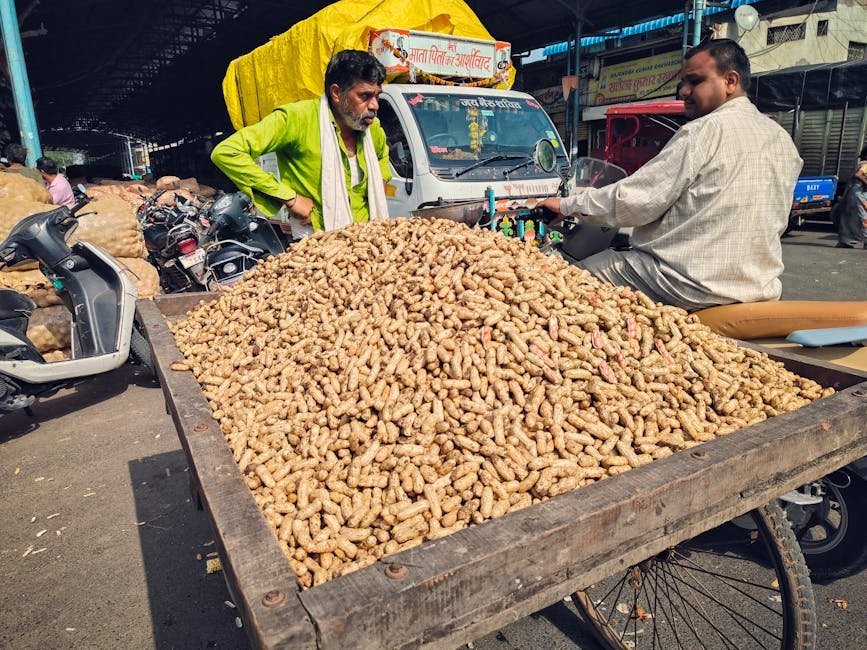
 Photo: Vivek Yadav · Pexels License · source ↗
Kadiri groundnut mandi
The Kadiri Agricultural Market Yard, in Kadiri town of Sri Sathya Sai district (formerly Anantapur), is one of Asia's largest groundnut auction mandis and the principal price-discovery node for kharif groundnut produced across the Rayalaseema dryland tract. It functions as a notified APMC market yard under the Andhra Pradesh State Agricultural Marketing Board and is integrated with the electronic National Agriculture Market (eNAM, see eNAM Electronic National Agriculture Market).
Overview
The yard auctions in-shell kharif groundnut arriving from cultivators in Kadiri, Mudigubba, Nallacheruvu, Tanakal, Talupula, Nallamada, Gandlapenta, Amadagur and adjacent mandals - the heart of Anantapur's rainfed groundnut belt. Daily arrivals during peak season (November-January) reach 5,000-15,000 quintals; off-season trade continues at 500-2,000 quintals/day. Buyers include oil millers from Tamil Nadu, Karnataka, Gujarat (Saurashtra) and seed traders from Andhra Pradesh and Telangana, plus confectionery exporters drawing premium Bold and Java grades.
Eligibility
Cultivators bringing groundnut to the yard need no licence; sale is mediated by licensed traders and commission agents (see Commission Agent Arthiya). Auctions are open-cry with sealed-tender alternatives for institutional buyers under eNAM. Traders, weighmen, hammala (loaders) and ancillary service providers operate under APMC licences issued by the state marketing board.
Benefit and structure
- Regulator: Andhra Pradesh State Agricultural Marketing Board / Kadiri APMC
- Trade volume: in peak November-January 2022-23 season, arrivals exceeded 4.5 lakh quintals
- Varieties traded: Kadiri-6 (K-6), Kadiri-9 (K-9), Dharani, Narayani, Kadiri Lepakshi, K-1812 and miscellaneous Spanish-bunch types
- Grades: Bold (large), Java (small), Karnataka Java, and locally graded categories based on kernel size and moisture
- Quality issues: aflatoxin contamination (see Aflatoxin Aspergillus Groundnut) is a persistent concern; arrivals with high moisture (>10 percent) or visible Aspergillus discoloration are heavily discounted by export-grade buyers
- MSP role: when market prices fall below the central MSP for groundnut, the AP State Civil Supplies Corporation and NAFED procure stock at MSP through the same yard
Implementation
Auctions begin at 7 AM and continue through the day. The auctioneer announces lot details (grade, origin, moisture); buyers bid openly; the commission agent confirms the highest bid; payment is mediated through the agent. Modern infrastructure includes covered auction sheds, drying yards, electronic weighing platforms, eNAM trading terminals and quality testing kiosks. The yard also hosts oil millers' direct purchase units that bypass the open auction during sustained low-price phases.
Adoption context
For Anantapur and Sri Sathya Sai farmers, Kadiri mandi is the dominant marketing channel for kharif groundnut. The yard's daily prices propagate across the Rayalaseema tract through Agmarknet and SMS price advisories. Farmers usually sell within 30-60 days of harvest because rainfed groundnut is highly aflatoxin-prone in on-farm storage; only well-cured low-moisture stocks are held back for end-season price gains. Cooperative drying and storage are still rare. FPO-mediated bulk sales through eNAM are slowly gaining adoption.
Related pages
See also: APMC Mandi, eNAM Electronic National Agriculture Market, Commission Agent Arthiya, Groundnut Crop, Aflatoxin Aspergillus Groundnut.
Sources
- Kadiri Agricultural Market Yard. AP State Agricultural Marketing Board.
- Kadiri groundnut prices. Agmarknet.
- Groundnut marketing in Anantapur. ICAR-Directorate of Groundnut Research.