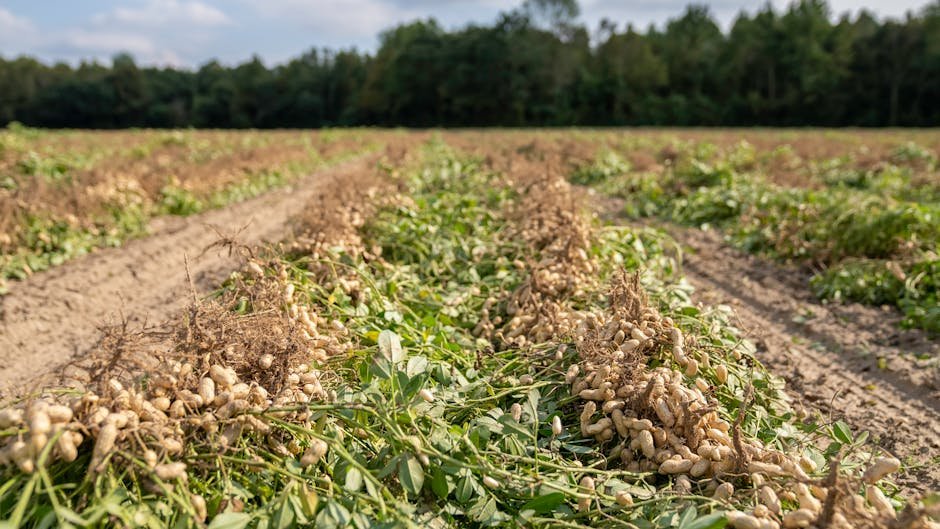
 Photo: Mark Stebnicki · Pexels License · source ↗
Vemana (TCGS-43) groundnut
Vemana, code TCGS-43, is a Spanish-bunch groundnut (Arachis hypogaea) variety released by ANGRAU's Regional Agricultural Research Station, Tirupati, for the rainfed groundnut tracts of southern Andhra Pradesh. The cultivar is named after the 17th-century Telugu poet-philosopher Vemana, in the ANGRAU tradition of naming rainfed varieties after regional saints and rivers (Kadiri Lepakshi, Kadiri Haritandhra, Greeshma, Narayani, Vemana). Vemana was specifically bred for drought tolerance under shallow red-loam conditions and is recommended for Anantapur, Chittoor and YSR Kadapa.
Key features
- Breeder: ANGRAU, RARS Tirupati
- Type: Spanish bunch
- Duration: 105-110 days (medium-short)
- Yield: 1,500-2,000 kg/ha pod yield rainfed; up to 2,500 kg/ha under one or two protective irrigations
- Pod: medium-sized, 2-seeded; rose-tan kernel of confectionery grade
- Shelling outturn: 70-72%
- Oil content: ~48-50% in kernel
- Plant type: erect bush; uniform pod-maturity, suitable for mechanical pod-stripping
Cultivation zones
Vemana is recommended for the southern Andhra Pradesh rainfed groundnut belt — Anantapur (eastern mandals around Penukonda, Hindupur, Madakasira), Chittoor district, and southern YSR Kadapa. The variety is also performed well in adjoining tracts of north Tamil Nadu (Krishnagiri, Vellore) under similar shallow red-loam conditions. ANGRAU and KVK Reddipalli include Vemana in their kharif demonstration packages along with Kadiri-6, K-9 and Narayani.
Standard package: kharif sowing in June-July with seed rate 120-150 kg/ha at 30 x 10 cm spacing; basal 20 kg N + 40 kg P2O5 + 40 kg K2O + 400 kg gypsum at flowering. Vemana responds well to dead-furrow moisture conservation (dead furrows) on undulating land.
Pests and diseases
Vemana shows:
- Field tolerance to leaf spots (early and late) and rust under moderate disease pressure; under heavy disease pressure prophylactic spray with tebuconazole + trifloxystrobin is still required
- Tolerance to drought during pod-development phase — recovers pod-fill better than K-6 under terminal drought
- Susceptibility to jassid and thrips at the seedling stage; standard imidacloprid seed treatment (5 g/kg seed) is recommended
- Susceptibility to aflatoxin contamination if harvested late in moist soil — strict harvest-timing and rapid drying are mandatory
Usage and adoption
Vemana is grown for both confectionery and oil-grade markets. Its rose-tan medium kernel fetches a 5-10% premium over K-6 in confectionery trade, which has driven adoption in Penukonda, Madakasira and Hindupur. The Anantapur Confectionery Groundnut Producer Cluster channels Vemana into export markets including Sri Lanka and West Asia. ANGRAU continues to produce breeder and foundation seed of Vemana through APSSDC.
Limitations
Vemana's yield ceiling under irrigation is slightly lower than newer hybrids such as Kadiri Lepakshi and Kadiri Amaravati. It is also susceptible to bud necrosis virus in late-sown crops where thrips populations are high. Seed-replacement rate is suboptimal because ANGRAU breeder seed supply does not always meet rainfed-season demand.
Related pages
See also: Groundnut crop overview, Kadiri-6 groundnut, K-9 groundnut, Narayani groundnut, Dharani groundnut, Anantapur district profile.
Sources
- Groundnut variety list. ANGRAU.
- Released groundnut varieties. ICAR-Directorate of Groundnut Research, Junagadh.
- Vemana TCGS-43 technical bulletin. KVK Reddipalli.