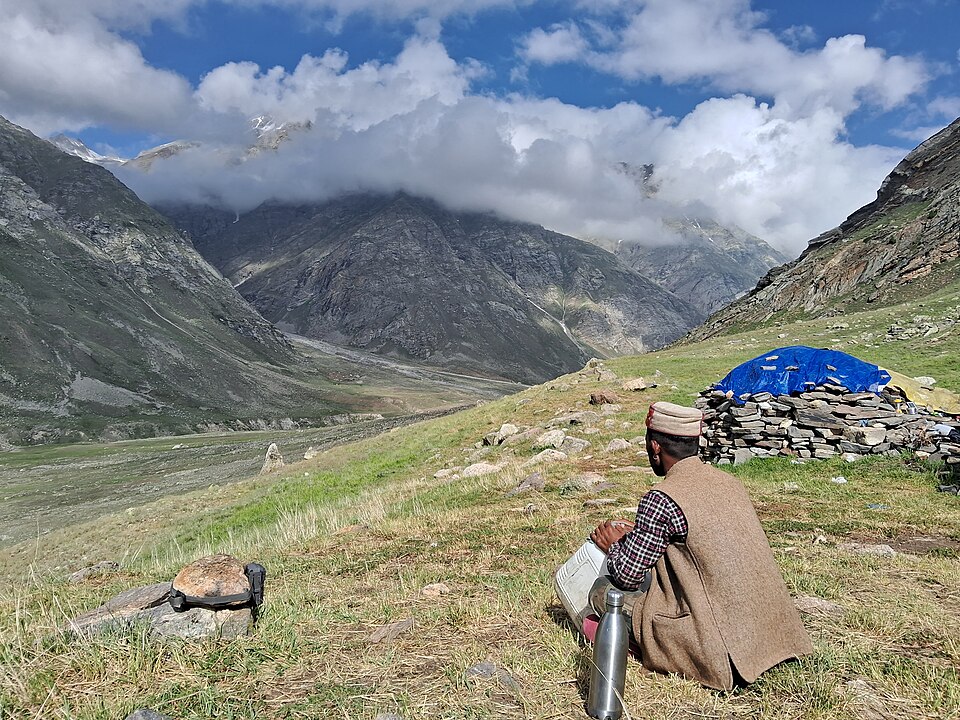
 Photo: Highland.dogs · CC BY-SA 4.0 · source ↗

Migratory (transhumant) sheep grazing
Migratory or transhumant sheep grazing is the seasonal long-distance movement of shared flocks of several hundred to two thousand or more sheep across forest, fallow and post-harvest farmland by specialist pastoralist communities. In the Deccan, the system is practised by the Kuruma and Golla communities of Telangana and Andhra Pradesh, the Kuruba of Karnataka and the Dhangar of Maharashtra; analogous systems run in Rajasthan, Gujarat and the western Himalayas under different community names.
Principle
Sheep flocks are walked between complementary forage zones across the agricultural calendar, so that the flock spends each season where green biomass is available. In the dry months, flocks graze cropped fields after harvest, eating stubble and weeds and depositing dung and urine that fertilises the next crop; in the monsoon, they return to home villages and graze commons and forest edges. The arrangement bypasses the need for cultivated fodder or year-round housing, but binds the flock's nutrition to the rotation of crops and rainfall over a wide landscape.
Implementation
Deccan flocks typically spend 8-11 months a year on the move. Shepherds return to home villages with the onset of the monsoon (around June), allow ewes to lamb and rebuild flock condition on local commons, and depart again after Diwali for the long migration cycle. Routes traditionally swing westward into the Maharashtra-Karnataka plateau or eastward through the Nallamala forests and Eastern Ghats. Camps are temporary brush or tarp shelters near a water source; flocks are penned on the field each night so that farmers receive the manure value. Cash income is earned from sale of ram lambs, breeding stock, woollen blankets (kambli) and contracted penning rights paid by crop farmers along the route.
Adoption context
The practice supports a substantial share of South Indian sheep meat production from breeds such as Nellore (Nellore Sheep) and Deccani. Many ram lambs from migratory flocks are sold to feedlots for short fattening before the Bakrid market (Ram Fattening Bakrid).
Limitations
Long-distance movement increases exposure to vector-borne diseases such as bluetongue (Bluetongue Sheep) and complicates structured vaccination (Small Ruminant Vaccination Schedule). Shrinking commons, fenced forests, highway expansion and conflicts with cultivators along stubble-grazing routes are progressively eroding the system. Migratory flocks are also incompatible with sedentary infrastructure such as elevated slatted-floor sheds (Elevated Goat Sheep Shed).
Related entries
See also: Bluetongue Sheep.
References
- Black sheep and gray wolves. India Seminar.
- Pastoralism in India — A Scoping Study. UK Government.