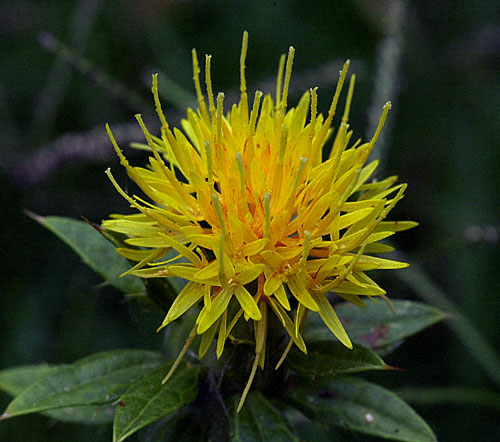
 Copyrighted free use · source ↗

Safflower (Carthamus tinctorius)
Safflower (Carthamus tinctorius L.) is a rainfed rabi oilseed of Maharashtra, Karnataka and AP, sown in late October-first week of November on deep black-cotton or clay-loam soils with neutral pH.
Key characteristics
- Mandate Institute: ICAR-IIOR Hyderabad; AICRP-Safflower
- High Oleic Varieties: ISF-1, ISF-2, ISF-3 (~75-76% oleic acid)
- Sowing Window: late October to first week of November
- India Area Trend: 712,500 ha (1996-97) -> 45,890 ha (2019-20)
- Soil Type: deep black-cotton/clay loams, pH 5-8
Cultivation and adoption
ICAR-IIOR Hyderabad coordinates AICRP-Safflower and has developed the first Indian high-oleic varieties ISF-1, ISF-2 and ISF-3 (~75-76% oleic acid, 30%+ oil). India's safflower area has shrunk from 712,500 ha (1996-97) to 45,890 ha (2019-20) because of biotic stresses and shifting crop economics.
References
- Safflower cultivars - ICAR-IIOR. https://icar-iior.org.in/technology/cultivars/safflower
- High Oleic Indian Safflower Cultivars - ScienceDirect. https://www.sciencedirect.com/science/article/abs/pii/S0926669017302327