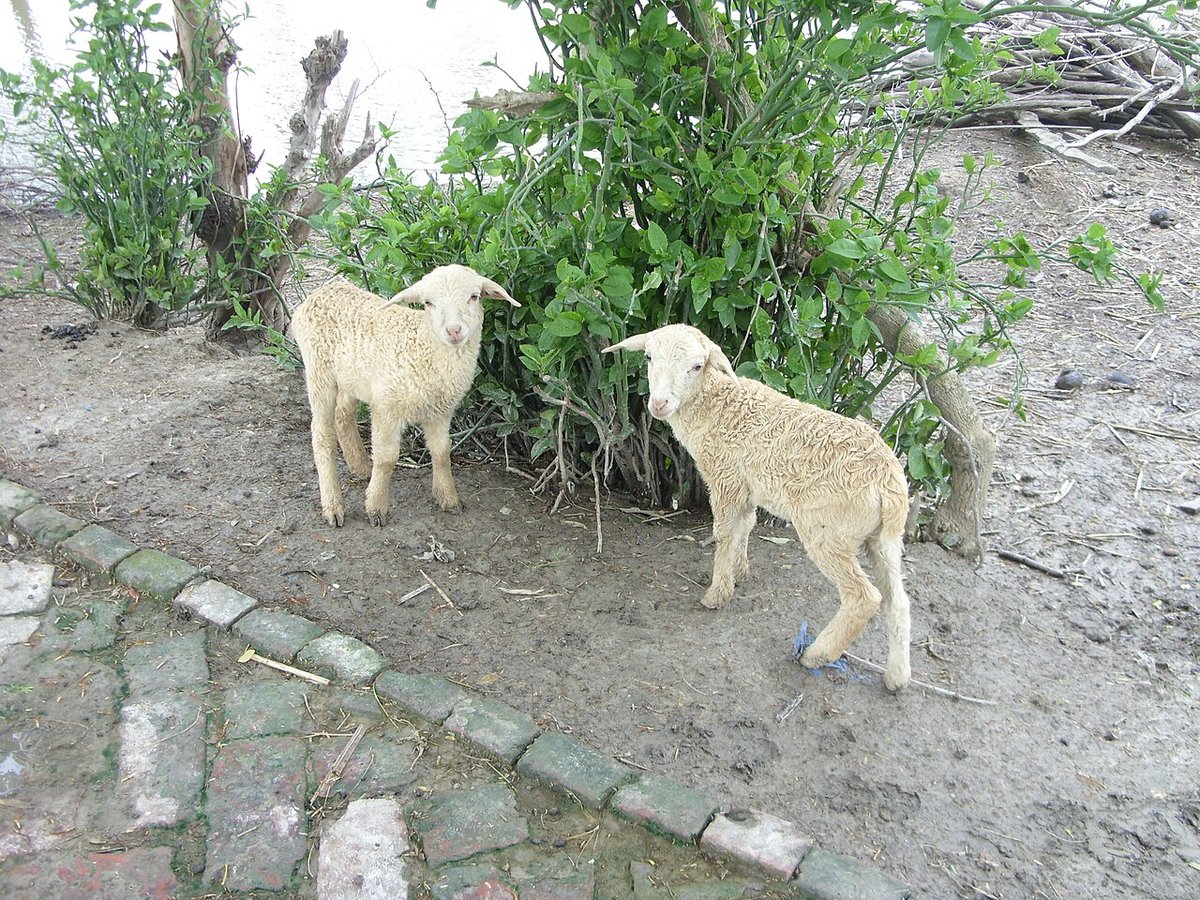
 Photo: Sutanu-1987 · CC BY-SA 4.0 · source ↗

Deccani sheep
Deccani is the dominant indigenous sheep breed of the southern Deccan plateau, registered with the ICAR National Bureau of Animal Genetic Resources (NBAGR) and present in vast numbers across Anantapur, Kurnool, Bellary, Kalaburagi, Solapur and the surrounding district cluster. It is the principal source of mutton and traditional kambli wool for the central Telangana, Rayalaseema and northern Karnataka belt.
Origin and distribution
The breeding tract spans parts of Maharashtra (Solapur, Osmanabad, Latur, Pune, Ahmadnagar), Karnataka (Kalaburagi, Bidar, Yadgir, Vijayapura, Ballari), Telangana (Mahbubnagar, Vikarabad) and the Rayalaseema districts of Andhra Pradesh. Most flocks belong to the Kuruba/Kuruma/Gowli pastoralist communities, who migrate seasonally through harvested groundnut, jowar and pulses lands.
Morphology
Deccani sheep are medium-sized, predominantly black, with grey, brown or pied animals also occurring. The body carries coarse hair-and-wool fleece used for the kambli blanket trade. Ears are medium-long, slightly drooping. Rams carry stout curving horns; the majority of ewes are polled. Tail is short and thin. Adult body weight averages 32-38 kg in rams and 25-30 kg in ewes.
Yield and productivity
Deccani is reared for the dual purpose of meat and coarse wool, with mutton now contributing most of the economic value. Lambing is single, with annual lambing interval and age at first lambing of 18-22 months. Greasy fleece yield is around 800 g per shearing, with two shearings per year. Mutton dressing percentage is 45-50 percent at 12-15 months. Fattened ram lambs targeting Bakrid (Ram Fattening Bakrid) reach 40-45 kg live weight.
Management
The breed is managed under three overlapping systems: long-distance transhumant grazing (Migratory Sheep Grazing), stationary mixed crop-livestock village flocks, and intensified peri-urban units with elevated slatted sheds. Vaccination (Small Ruminant Vaccination Schedule) against PPR, enterotoxaemia, sheep pox and FMD anchors the herd-health calendar; bluetongue (Bluetongue Sheep) is a significant kharif-season cause of loss in the Deccani belt. ICAR-CSWRI and KVAFSU run targeted improvement programmes against the breed standard.
Related pages
See also: Bellary sheep, Nellore sheep, Migratory sheep grazing, Bluetongue in sheep.
Sources
- Deccani Sheep — NBAGR breed descriptor. ICAR-National Bureau of Animal Genetic Resources.
- Status of Deccani sheep. ICAR-Central Sheep and Wool Research Institute.